Dock Identification vs Test Identification Parade: Supreme Court Clarifies the Law
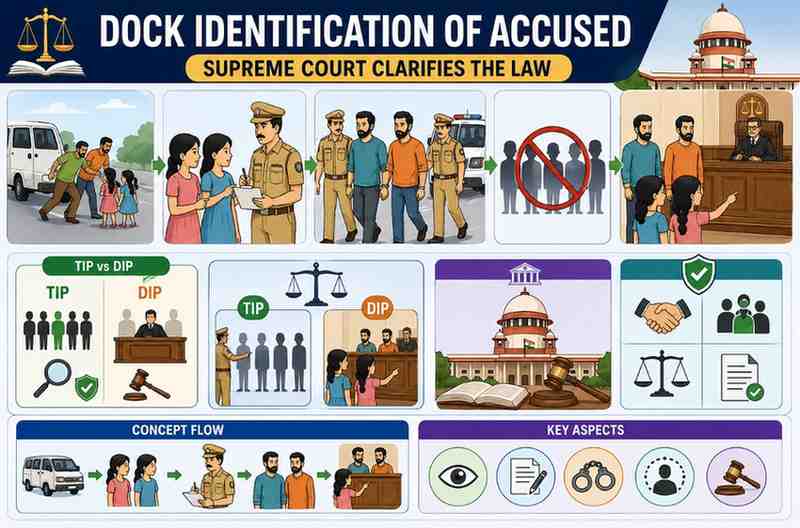
June 9, 2026
Dock Identification (DIP) without Test Identification Parade (TIP) is not always fatal if the accused is clearly identified.
The Supreme Court in Harjindra Singh & Ors. v. State of U.P. (2026) recently clarified that absence of TIP does not automatically weaken the prosecution, especially when the accused is identified in court (Dock Identification) and other strong circumstances exist. This has become important in criminal trials dealing with identification evidence.
Legal Issue
Whether Dock Identification (identifying accused in court) is reliable without prior Test Identification Parade (TIP) conducted during investigation.
Imagine a quiet morning suddenly turning into panic—two young girls are abducted by unknown men in a vehicle. The kidnappers demand ransom, and the family is left in fear and helplessness. However, during the ordeal, the victims closely observe the accused—their faces, clothes, and physical features.
Soon after the crime, police act swiftly and arrest the suspects almost immediately. The victims narrate what they saw and give a clear description in the complaint itself.
Now comes the crucial part:
Normally, police conduct a Test Identification Parade (TIP)—a pre-trial procedure where witnesses identify suspects among strangers. But in this case, no TIP was conducted.
During the trial, the victims identify the accused directly in court—this is called Dock Identification (DIP).
The defense argues:
“No TIP = weak case.”
But the Supreme Court disagrees.
The Court observed:
- TIP is only a rule of prudence, not a strict legal requirement.
- If the witness had sufficient opportunity to see the accused (like close interaction during kidnapping), their identification in court can be trusted.
- If the accused were arrested immediately after the crime, chances of mistaken identity are reduced.
- If the accused were properly described in the FIR/complaint , it strengthens the prosecution case.
Thus, even without TIP, the Court upheld the conviction because:
✔ Victims had direct interaction with accused
✔ Clear physical features were noted
✔ Immediate arrest reduced doubt
✔ Strong Dock Identification in court
Finally, the Supreme Court dismissed the appeal and upheld conviction for kidnapping and ransom.
Landmark Cases
1. Harjindra Singh & Ors. v. State of U.P. (2026 SC)
Held: Dock Identification valid even without TIP if supported by strong evidence.
2. Budhsen v. State of U.P., AIR 1970 SC 1321
TIP is not substantive evidence, only corroborative.
3. Kanta Prashad v. Delhi Administration, AIR 1958 SC 350
Failure to hold TIP is not fatal if witness identifies accused in court.
4. Dana Yadav v. State of Bihar, (2002) 7 SCC 295
Dock Identification can be relied upon if witness is trustworthy.
Importance
- Helps courts avoid technical acquittals due to absence of TIP
- Protects justice where victims clearly remember the accused
- Ensures criminals do not escape due to procedural gaps
- Balances fair trial rights vs effective prosecution
Exam Snapshot (For Judiciary/UPSC)
TIP (Test Identification Parade)
→ Conducted during investigation
→ Corroborative evidence
→ Not mandatory
DIP (Dock Identification)
→ Identification in court
→ Substantive evidence
Key Rule
→ TIP absence ≠ case failure
When DIP is reliable?
✔ Immediate arrest
✔ Clear FIR description
✔ Direct interaction with accused
✔ Distinctive features observed
डॉक आइडेंटिफिकेशन बनाम टेस्ट आइडेंटिफिकेशन परेड: सुप्रीम कोर्ट का महत्वपूर्ण फैसला
अगर आरोपी की पहचान स्पष्ट हो, तो TIP के बिना भी Dock Identification (कोर्ट में पहचान) मान्य हो सकती है।
Harjindra Singh & Ors. v. State of U.P. (2026) में सुप्रीम कोर्ट ने कहा कि TIP न होने से केस कमजोर नहीं होता, यदि कोर्ट में पहचान (Dock Identification) और अन्य परिस्थितियाँ मजबूत हों।
कानूनी मुद्दा
क्या **बिना Test Identification Parade (TIP)** के **Dock Identification (कोर्ट में पहचान)** भरोसेमंद मानी जा सकती है?
एक सामान्य सुबह अचानक डर में बदल जाती है, जब दो छोटी लड़कियों का अपहरण हो जाता है। अपहरणकर्ता फिरौती मांगते हैं और परिवार घबराहट में डूब जाता है।
लेकिन इस दौरान लड़कियाँ अपहरणकर्ताओं को ध्यान से देखती हैं—उनका चेहरा, कपड़े और हाव-भाव याद रखती हैं।
पुलिस तुरंत कार्रवाई करती है और आरोपियों को जल्दी ही पकड़ लेती है। लड़कियाँ FIR में ही आरोपियों का **स्पष्ट विवरण देती हैं**।
अब महत्वपूर्ण बात आती है—
आमतौर पर पुलिस **Test Identification Parade (TIP)** कराती है, जिसमें गवाह आरोपी को पहचानते हैं। लेकिन इस केस में TIP नहीं हुआ।
ट्रायल के दौरान लड़कियाँ कोर्ट में आरोपियों की पहचान करती हैं—इसे **Dock Identification (DIP)** कहते हैं।
बचाव पक्ष कहता है:
“TIP नहीं हुआ, इसलिए केस कमजोर है।”
लेकिन सुप्रीम कोर्ट ने यह तर्क खारिज कर दिया।
कोर्ट ने कहा:
- TIP केवल सावधानी का नियम है, जरूरी नहीं है।
- यदि गवाह को आरोपी को देखने का **पर्याप्त मौका मिला, तो कोर्ट में पहचान विश्वसनीय है।
- यदि आरोपी को तुरंत गिरफ्तार किया गया , तो गलत पहचान की संभावना कम होती है।
- यदि FIR में आरोपी का स्पष्ट विवरण दिया गया , तो यह prosecution को मजबूत करता है।
इसलिए कोर्ट ने माना कि:
- गवाहों ने आरोपी को करीब से देखा
- पहचान के लिए स्पष्ट विवरण था
- तुरंत गिरफ्तारी हुई
- कोर्ट में पहचान मजबूत थी
अंत में सुप्रीम कोर्ट ने दोष सिद्धि को बरकरार रखा और अपील खारिज कर दी।
लैंडमार्क केस
1. Harjindra Singh & Ors. v. State of U.P. (2026 SC)
सिद्धांत: TIP के बिना भी Dock Identification मान्य हो सकती है।
2. Budhsen v. State of U.P., AIR 1970 SC 1321
TIP केवल सहायक साक्ष्य है, मुख्य साक्ष्य नहीं।
3. Kanta Prashad v. Delhi Administration, AIR 1958 SC 350
TIP न होना केस के लिए घातक नहीं है।
4. Dana Yadav v. State of Bihar, (2002) 7 SCC 295
यदि गवाह विश्वसनीय है, तो Dock Identification पर भरोसा किया जा सकता है।
महत्व
- तकनीकी कारणों से अपराधी बच न सकें
- पीड़ित की पहचान को महत्व मिलता है
- न्याय प्रणाली अधिक व्यावहारिक बनती है
- निष्पक्ष सुनवाई और न्याय के बीच संतुलन बनता है
परीक्षा के लिए मुख्य बिंदु
TIP (Test Identification Parade)
→ जांच के दौरान होता है
→ सहायक साक्ष्य
→ अनिवार्य नहीं
DIP (Dock Identification)
→ कोर्ट में पहचान
→ मुख्य साक्ष्य
मुख्य सिद्धांत
→ TIP न होना = केस खत्म नहीं
कब DIP मजबूत है?
✔ तुरंत गिरफ्तारी
✔ FIR में स्पष्ट विवरण
✔ आरोपी से सीधा संपर्क
✔ विशिष्ट पहचान (features)
---