DNA Test vs Legal Presumption
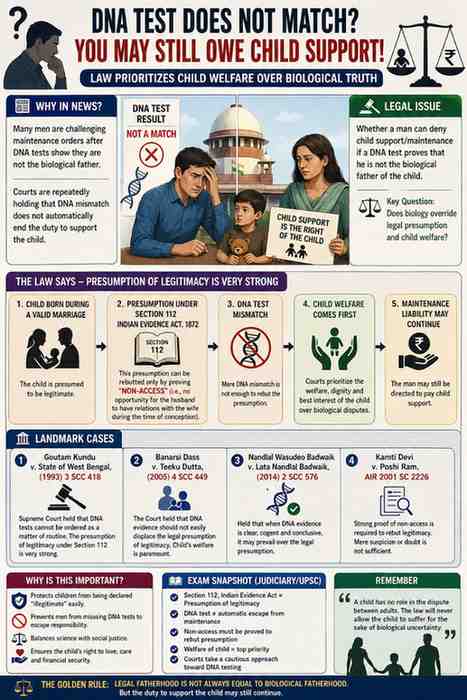 The Supreme Court has recently clarified an important legal position regarding child maintenance and paternity, holding that when a DNA test conclusively establishes that a man is not the biological father of a child, he cannot be compelled to pay maintenance for that child, even if the child was born during a valid marriage. This issue came into prominence following the judgment in Nikhat Parveen @ Khusboo Khatoon v. Rafique @ Shillu (28 April 2025), where the Court emphasized that clear and reliable scientific evidence can override the statutory presumption of legitimacy under Section 112 of the Indian Evidence Act, 1872. The case arose from a marriage solemnized in 2016, where the couple initially lived together peacefully but later developed disputes, leading the wife to file proceedings under the Protection of Women from Domestic Violence Act, 2005, seeking maintenance for herself and her child. During the course of litigation, the husband raised doubts about the child’s paternity and sought a DNA test, which the court permitted; the test was conducted with due consent and proper procedure. The DNA report categorically established that the husband was not the biological father of the child.
Despite this finding, the wife continued to claim maintenance for the child, relying on the legal presumption under Section 112, which treats a child born during the subsistence of a valid marriage as legitimate. This created a conflict between a long-standing legal presumption and modern scientific evidence. The Trial Court rejected the claim for the child’s maintenance, and this decision was subsequently affirmed by the Delhi High Court, after which the matter reached the Supreme Court. The apex court carefully weighed the strength of the statutory presumption against the evidentiary value of DNA testing and held that while Section 112 embodies a strong presumption, it is not absolute and can be rebutted by conclusive scientific proof. The Court ruled that where a DNA test is clear, reliable, and unchallenged, scientific truth must prevail over legal fiction, and therefore, a man cannot be forced to bear maintenance liability for a child whose paternity has been definitively disproved.
At the same time, the Court ensured that the child’s welfare was not neglected, directing the Women and Child Development Department, Delhi, to take appropriate steps to safeguard the child’s upbringing, education, and overall well-being. This approach reflects a balance between preventing injustice to an individual and protecting the interests of the child through state intervention. The judgment builds upon earlier precedents such as Goutam Kundu v. State of West Bengal, which cautioned against routine use of DNA tests and upheld the strength of the presumption of legitimacy, and Nandlal Wasudeo Badwaik v. Lata Nandlal Badwaik, where the Court recognized that scientific evidence may prevail over legal presumption in appropriate circumstances. Overall, the ruling marks a significant development in family law by affirming that conclusive DNA evidence can rebut the presumption under Section 112, ensuring fairness to individuals while simultaneously safeguarding child welfare through alternative mechanisms.
The Supreme Court carefully examined two important aspects:
1. The strength of legal presumption under Section 112
2. The reliability of scientific evidence (DNA test)
The Court held that when a DNA test is conclusive, undisputed, and conducted properly scientific truth must prevail over legal presumption.
Thus, it ruled that:
A man cannot be forced to pay maintenance if DNA proves he is not the father. Even if the child was born during marriage, this presumption can be rebutted by strong scientific evidence.
However, the Court did not ignore the child’s welfare. It directed authorities (Women & Child Development Department, Delhi) to ensure that the child’s living conditions, education, and basic needs are properly taken care of.
Landmark Cases
1. Nikhat Parveen @ Khusboo Khatoon v. Rafique @ Shillu
The Supreme Court held that conclusive DNA evidence overrides Section 112 presumption; no maintenance liability if paternity is disproved.
2. Goutam Kundu v. State of West Bengal, (1993) 3 SCC 418
DNA tests should not be ordered routinely; presumption of legitimacy is strong.
3. Nandlal Wasudeo Badwaik v. Lata Nandlal Badwaik, (2014) 2 SCC 576
The Supreme Court held that scientific evidence (DNA) may prevail over legal presumption in appropriate cases.
It is important because it:
1. Ensures fairness to men wrongly held liable
2. Recognizes scientific evidence (DNA) as decisive
3. Balances law with modern technology
4. Still protects child welfare through State support
Exam Snapshot
1. Section 112 Evidence Act → Presumption of legitimacy
2. DNA test (conclusive) → Can rebut presumption
3. Key case: Nikhat Parveen (2025)
4. Court ensures child welfare separately
सुप्रीम कोर्ट ने हाल ही में पितृत्व और बाल भरण-पोषण से जुड़े एक महत्वपूर्ण कानूनी प्रश्न पर स्पष्टता प्रदान करते हुए कहा है कि यदि DNA परीक्षण से यह निर्णायक रूप से सिद्ध हो जाता है कि कोई व्यक्ति बच्चे का जैविक पिता नहीं है, तो उसे उस बच्चे का भरण-पोषण करने के लिए बाध्य नहीं किया जा सकता, भले ही बच्चा वैध विवाह के दौरान जन्मा हो। यह मुद्दा विशेष रूप से Nikhat Parveen @ Khusboo Khatoon v. Rafique @ Shillu (28 अप्रैल 2025) के निर्णय के बाद चर्चा में आया, जिसमें न्यायालय ने यह स्पष्ट किया कि जब वैज्ञानिक साक्ष्य स्पष्ट, विश्वसनीय और निर्विवाद हो, तो वह भारतीय साक्ष्य अधिनियम, 1872 की धारा 112 के अंतर्गत स्थापित वैधता की कानूनी धारणा पर प्रधानता प्राप्त कर सकता है। इस मामले की पृष्ठभूमि में 2016 का एक विवाह था, जिसमें प्रारंभिक समय में दंपति का जीवन सामान्य रहा, लेकिन बाद में विवाद उत्पन्न हो गए। इसके बाद पत्नी ने घरेलू हिंसा अधिनियम, 2005 के तहत अपने और अपने बच्चे के लिए भरण-पोषण की मांग करते हुए वाद दायर किया। कार्यवाही के दौरान पति ने बच्चे के पितृत्व पर संदेह व्यक्त किया और DNA परीक्षण की मांग की, जिसे न्यायालय ने अनुमति दी; यह परीक्षण विधिसम्मत प्रक्रिया और दोनों पक्षों की सहमति से किया गया। परीक्षण रिपोर्ट में स्पष्ट रूप से यह स्थापित हुआ कि पति बच्चे का जैविक पिता नहीं है।
इसके बावजूद पत्नी ने यह तर्क देते हुए बच्चे के भरण-पोषण की मांग जारी रखी कि बच्चा वैध विवाह के दौरान जन्मा है, अतः धारा 112 के अनुसार उसे वैध माना जाएगा। इस प्रकार एक ओर कानूनी धारणा और दूसरी ओर वैज्ञानिक प्रमाण के बीच टकराव उत्पन्न हुआ। ट्रायल कोर्ट ने बच्चे के लिए भरण-पोषण देने से इंकार कर दिया, जिसे दिल्ली उच्च न्यायालय ने भी बरकरार रखा, और अंततः मामला सुप्रीम कोर्ट के समक्ष पहुँचा। सुप्रीम कोर्ट ने इस संदर्भ में धारा 112 की प्रबल धारणा और DNA परीक्षण की प्रमाणिकता दोनों का विश्लेषण किया और यह निर्णय दिया कि यद्यपि वैधता की धारणा अत्यंत सशक्त है, फिर भी यह पूर्णतः निरपेक्ष नहीं है और इसे ठोस वैज्ञानिक साक्ष्य द्वारा खंडित किया जा सकता है। न्यायालय ने स्पष्ट किया कि जहाँ DNA परीक्षण स्पष्ट, विश्वसनीय और विवादरहित हो, वहाँ वैज्ञानिक सत्य को कानूनी कल्पना पर वरीयता दी जानी चाहिए, और ऐसी स्थिति में उस व्यक्ति पर भरण-पोषण का दायित्व नहीं डाला जा सकता जिसका पितृत्व निर्णायक रूप से अस्वीकृत हो चुका है।
साथ ही, न्यायालय ने बच्चे के हितों की अनदेखी नहीं की और महिला एवं बाल विकास विभाग, दिल्ली को निर्देश दिया कि बच्चे की शिक्षा, पालन-पोषण और समुचित जीवन स्तर सुनिश्चित किया जाए। इस प्रकार न्यायालय ने एक संतुलित दृष्टिकोण अपनाते हुए एक ओर व्यक्ति के साथ होने वाले संभावित अन्याय को रोका और दूसरी ओर राज्य के माध्यम से बच्चे के कल्याण को सुनिश्चित किया। यह निर्णय पूर्ववर्ती मामलों जैसे Goutam Kundu v. State of West Bengal, जिसमें DNA परीक्षण के अनावश्यक उपयोग के विरुद्ध चेतावनी दी गई थी, तथा Nandlal Wasudeo Badwaik v. Lata Nandlal Badwaik, जिसमें उपयुक्त परिस्थितियों में वैज्ञानिक साक्ष्य को प्राथमिकता दी गई थी, के अनुरूप है। समग्र रूप से यह निर्णय पारिवारिक विधि के क्षेत्र में एक महत्वपूर्ण प्रगति को दर्शाता है, जिसमें यह स्थापित किया गया है कि स्पष्ट DNA साक्ष्य धारा 112 की धारणा को खंडित कर सकता है, जिससे न्याय और वैज्ञानिक सच्चाई के बीच संतुलन स्थापित होता है, साथ ही बच्चे के हितों की सुरक्षा भी सुनिश्चित रहती है।
सुप्रीम कोर्ट ने कहा कि:
जब DNA टेस्ट स्पष्ट और बिना विवाद के हो और यह साबित कर दे कि व्यक्ति पिता नहीं है तो वैज्ञानिक सच्चाई को प्राथमिकता दी जाएगी।
इसलिए कोर्ट ने फैसला दिया कि:
1. ऐसे व्यक्ति को मेंटेनेंस देने के लिए मजबूर नहीं किया जा सकता
2. भले ही बच्चा शादी के दौरान पैदा हुआ हो
लेकिन कोर्ट ने बच्चे के हित को नजरअंदाज नहीं किया। उसने दिल्ली सरकार के महिला एवं बाल विकास विभाग को निर्देश दिया कि बच्चे की पढ़ाई, स्वास्थ्य और जीवन स्तर का ध्यान रखा जाए।
लैंडमार्क केस
1. Nikhat Parveen @ Khusboo Khatoon v. Rafique @ Shillu
सुप्रीम कोर्ट ने कहा कि स्पष्ट DNA रिपोर्ट कानूनी धारणा से ऊपर है; पिता न होने पर मेंटेनेंस नहीं देना होगा।
2. Goutam Kundu v. State of West Bengal, (1993) 3 SCC 418
DNA टेस्ट हर मामले में नहीं होना चाहिए; वैधता की धारणा मजबूत है।
3. Nandlal Wasudeo Badwaik v. Lata Nandlal Badwaik, (2014) 2 SCC 576
सही परिस्थितियों में DNA रिपोर्ट को प्राथमिकता दी जा सकती है।
महत्व
1. गलत व्यक्ति पर जिम्मेदारी नहीं डाली जाएगी
2. विज्ञान (DNA) को कानूनी मान्यता
3. न्याय और तकनीक का संतुलन
4. बच्चे की सुरक्षा सरकार के माध्यम से सुनिश्चित
परीक्षा के लिए मुख्य बिंद
1. धारा 112 साक्ष्य अधिनियम → वैधता की धारणा
2. DNA रिपोर्ट (स्पष्ट) → धारणा को तोड़ सकती है
3. मुख्य केस: Nikhat Parveen (2025)
4. वैज्ञानिक साक्ष्य को प्राथमिकता
5. बच्चे के हित की अलग से सुरक्षा