Delimitation Bill & the Future of Political Representation in India
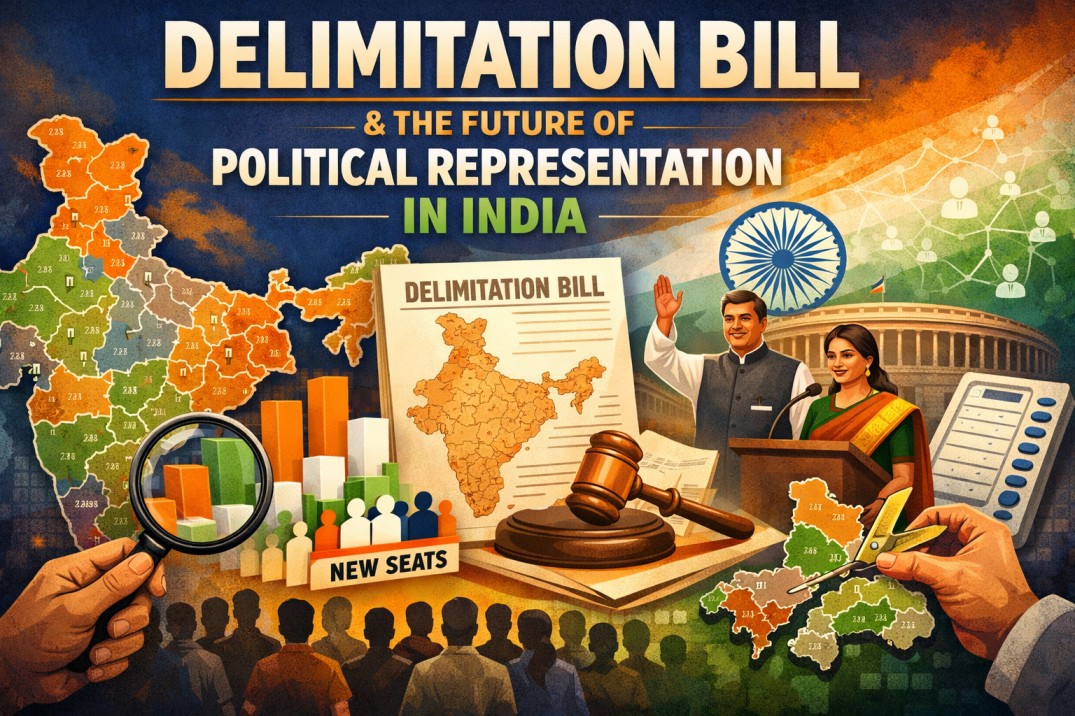
Summary: The Delimitation Bill seeks to redraw electoral constituencies based on population changes, raising major legal and political debates.
Why in News:
The issue of delimitation has become trending due to discussions around conducting fresh delimitation after 2026, when the constitutional freeze on seat redistribution (based on population) is expected to end. Concerns are rising about its impact on federal balance, representation, and political power among states.
Legal Issue:
Whether delimitation based purely on population violates the principle of federalism and equality among states, especially when some states have successfully controlled population growth while others have not.
Full Story:
Imagine a classroom where seats are assigned based on the number of students in each section. Over time, some sections grow bigger, while others remain small. Naturally, you may want to redistribute seats to maintain fairness. This is exactly what delimitation does in a democracy.
In India, delimitation means redrawing the boundaries of Lok Sabha and State Assembly constituencies to reflect population changes. It is carried out by a Delimitation Commission under the Delimitation Commission Act.
After independence, delimitation was conducted multiple times—1952, 1963, 1973, and 2002. However, during the 1970s, India faced rapid population growth. To encourage family planning, the government decided to freeze the number of seats in Parliament and State Assemblies based on the 1971 Census. This freeze was extended through the 42nd Constitutional Amendment (1976) and later the 84th Amendment (2001), which continued the freeze until 2026.
Now, as 2026 approaches, the debate is intense. States like Uttar Pradesh and Bihar have seen high population growth and may gain more seats if delimitation is done. On the other hand, southern states like Tamil Nadu and Kerala, which controlled population growth effectively, fear losing political representation.
This raises a constitutional dilemma: Should representation be strictly based on population (Article 81), or should fairness to states that followed national policies also be considered?
Another concern is political imbalance. A higher number of seats in certain states could shift power in Parliament, affecting national policymaking. Critics argue this may weaken the spirit of cooperative federalism.
Supporters, however, say democracy demands “one person, one vote, one value,” and representation must reflect actual population.
Thus, the Delimitation Bill or future delimitation exercise is not just a technical adjustment—it is a deeply political and constitutional issue that will shape India’s democratic future.
- Landmark Cases:
Meghraj Kothari v. Delimitation Commission, AIR 1967 SC 669
The Supreme Court held that orders of the Delimitation Commission cannot be challenged in court, ensuring finality to the delimitation process.
Lakshmi Charan Sen v. A.K.M. Hassan Uzzaman, AIR 1985 SC 1233
The Court emphasized that electoral rolls and delimitation are essential for free and fair elections and should not be easily interfered with.
Importance:
Delimitation directly affects political representation. It determines how many MPs/MLAs represent citizens. It impacts voting power, regional balance, and fairness in democracy. For a common citizen, it decides how strong their voice is in governance.
Exam Snapshot:
Delimitation = Redrawing of constituency boundaries
Based on Census data
Freeze on seats till 2026 (84th Amendment)
Key Articles: Article 81, 82, 170
Conducted by Delimitation Commission
Not subject to judicial review (mostly)
Major debate: Population vs Federal fairness
Summary: The Delimitation Bill seeks to redraw electoral constituencies based on population changes, raising major legal and political debates.
Why in News:
The issue of delimitation has become trending due to discussions around conducting fresh delimitation after 2026, when the constitutional freeze on seat redistribution (based on population) is expected to end. Concerns are rising about its impact on federal balance, representation, and political power among states.
Legal Issue:
Whether delimitation based purely on population violates the principle of federalism and equality among states, especially when some states have successfully controlled population growth while others have not.
Full Story:
Imagine a classroom where seats are assigned based on the number of students in each section. Over time, some sections grow bigger, while others remain small. Naturally, you may want to redistribute seats to maintain fairness. This is exactly what delimitation does in a democracy.
In India, delimitation means redrawing the boundaries of Lok Sabha and State Assembly constituencies to reflect population changes. It is carried out by a Delimitation Commission under the Delimitation Commission Act.
After independence, delimitation was conducted multiple times—1952, 1963, 1973, and 2002. However, during the 1970s, India faced rapid population growth. To encourage family planning, the government decided to freeze the number of seats in Parliament and State Assemblies based on the 1971 Census. This freeze was extended through the 42nd Constitutional Amendment (1976) and later the 84th Amendment (2001), which continued the freeze until 2026.
Now, as 2026 approaches, the debate is intense. States like Uttar Pradesh and Bihar have seen high population growth and may gain more seats if delimitation is done. On the other hand, southern states like Tamil Nadu and Kerala, which controlled population growth effectively, fear losing political representation.
This raises a constitutional dilemma: Should representation be strictly based on population (Article 81), or should fairness to states that followed national policies also be considered?
Another concern is political imbalance. A higher number of seats in certain states could shift power in Parliament, affecting national policymaking. Critics argue this may weaken the spirit of cooperative federalism.
Supporters, however, say democracy demands “one person, one vote, one value,” and representation must reflect actual population.
Thus, the Delimitation Bill or future delimitation exercise is not just a technical adjustment—it is a deeply political and constitutional issue that will shape India’s democratic future.
Meghraj Kothari v. Delimitation Commission, AIR 1967 SC 669
The Supreme Court held that orders of the Delimitation Commission cannot be challenged in court, ensuring finality to the delimitation process.
Lakshmi Charan Sen v. A.K.M. Hassan Uzzaman, AIR 1985 SC 1233
The Court emphasized that electoral rolls and delimitation are essential for free and fair elections and should not be easily interfered with.
Importance:
Delimitation directly affects political representation. It determines how many MPs/MLAs represent citizens. It impacts voting power, regional balance, and fairness in democracy. For a common citizen, it decides how strong their voice is in governance.
Exam Snapshot:
Delimitation = Redrawing of constituency boundaries
Based on Census data
Freeze on seats till 2026 (84th Amendment)
Key Articles: Article 81, 82, 170
Conducted by Delimitation Commission
Not subject to judicial review (mostly)
Major debate: Population vs Federal fairness
शीर्षक: परिसीमन विधेयक: लोकतंत्र की सीमाओं का पुनर्निर्धारण
सारांश:
परिसीमन विधेयक जनसंख्या के आधार पर निर्वाचन क्षेत्रों को पुनः निर्धारित करने का प्रयास है, जिससे बड़ा संवैधानिक और राजनीतिक विवाद खड़ा हो गया है।खबरों में क्यों?:
2026 के बाद परिसीमन की प्रक्रिया शुरू होने की संभावना है क्योंकि अभी तक सीटों के पुनर्वितरण पर लगी रोक खत्म होने वाली है। इससे राज्यों के बीच राजनीतिक संतुलन और प्रतिनिधित्व को लेकर बहस तेज हो गई है।कानूनी मुद्दा:
क्या केवल जनसंख्या के आधार पर परिसीमन करना संघवाद और राज्यों के बीच समानता के सिद्धांत का उल्लंघन करता है?पूरी कहानी:
मान लीजिए एक स्कूल में अलग-अलग कक्षाओं में छात्रों की संख्या बदलती रहती है। कुछ कक्षाएं बड़ी हो जाती हैं और कुछ छोटी। ऐसे में सीटों का बंटवारा फिर से करना जरूरी हो जाता है। यही काम लोकतंत्र में परिसीमन करता है।
भारत में परिसीमन का मतलब है लोकसभा और विधानसभा क्षेत्रों की सीमाओं को जनसंख्या के अनुसार बदलना। यह काम परिसीमन आयोग करता है, जो एक स्वतंत्र संस्था होती है।
स्वतंत्रता के बाद 1952, 1963, 1973 और 2002 में परिसीमन हुआ। लेकिन 1970 के दशक में जनसंख्या तेजी से बढ़ने लगी। इसे नियंत्रित करने के लिए सरकार ने 1971 की जनगणना के आधार पर सीटों को फ्रीज कर दिया। यह फ्रीज 42वें संशोधन (1976) और फिर 84वें संशोधन (2001) के जरिए 2026 तक बढ़ा दिया गया।
अब 2026 करीब है, तो बहस तेज हो गई है। उत्तर प्रदेश और बिहार जैसे राज्यों की जनसंख्या ज्यादा बढ़ी है, इसलिए उन्हें ज्यादा सीटें मिल सकती हैं। जबकि तमिलनाडु और केरल जैसे राज्यों ने जनसंख्या नियंत्रण में सफलता पाई है, इसलिए वे अपनी सीटें कम होने से डर रहे हैं।
यहां एक बड़ा सवाल उठता है—क्या प्रतिनिधित्व केवल जनसंख्या के आधार पर होना चाहिए या उन राज्यों को भी ध्यान में रखना चाहिए जिन्होंने सरकारी नीतियों का पालन किया?
इसके अलावा, राजनीतिक असंतुलन का खतरा भी है। कुछ राज्यों की सीटें बढ़ने से संसद में उनकी ताकत बढ़ जाएगी, जिससे नीति निर्माण पर असर पड़ सकता है।
समर्थकों का कहना है कि लोकतंत्र में “एक व्यक्ति, एक वोट, एक मूल्य” होना चाहिए, इसलिए जनसंख्या के अनुसार प्रतिनिधित्व जरूरी है।
इस प्रकार, परिसीमन केवल सीमाओं का बदलाव नहीं है, बल्कि यह भारत के लोकतंत्र की दिशा तय करने वाला बड़ा मुद्दा है।
लैंडमार्क केस:
Meghraj Kothari v. Delimitation Commission, AIR 1967 SC 669
सुप्रीम कोर्ट ने कहा कि परिसीमन आयोग के आदेश को अदालत में चुनौती नहीं दी जा सकती, जिससे प्रक्रिया की अंतिमता बनी रहती है।Lakshmi Charan Sen v. A.K.M. Hassan Uzzaman, AIR 1985 SC 1233
कोर्ट ने कहा कि निष्पक्ष चुनाव के लिए परिसीमन और मतदाता सूची बहुत जरूरी है और इसमें ज्यादा हस्तक्षेप नहीं होना चाहिए।
महत्व:
परिसीमन से तय होता है कि कितने सांसद/विधायक जनता का प्रतिनिधित्व करेंगे। इससे आम नागरिक की आवाज की ताकत और राजनीतिक संतुलन प्रभावित होता है।परीक्षा के लिए मुख्य बिंदु:
परिसीमन = निर्वाचन क्षेत्रों का पुनर्निर्धारण
जनगणना के आधार पर
2026 तक सीटें फ्रीज (84वां संशोधन)
प्रमुख अनुच्छेद: 81, 82, 170
परिसीमन आयोग द्वारा किया जाता है
न्यायिक समीक्षा सीमित
मुख्य विवाद: जनसंख्या बनाम संघीय संतुलन