Article 21 and the Right to Appear in Examination
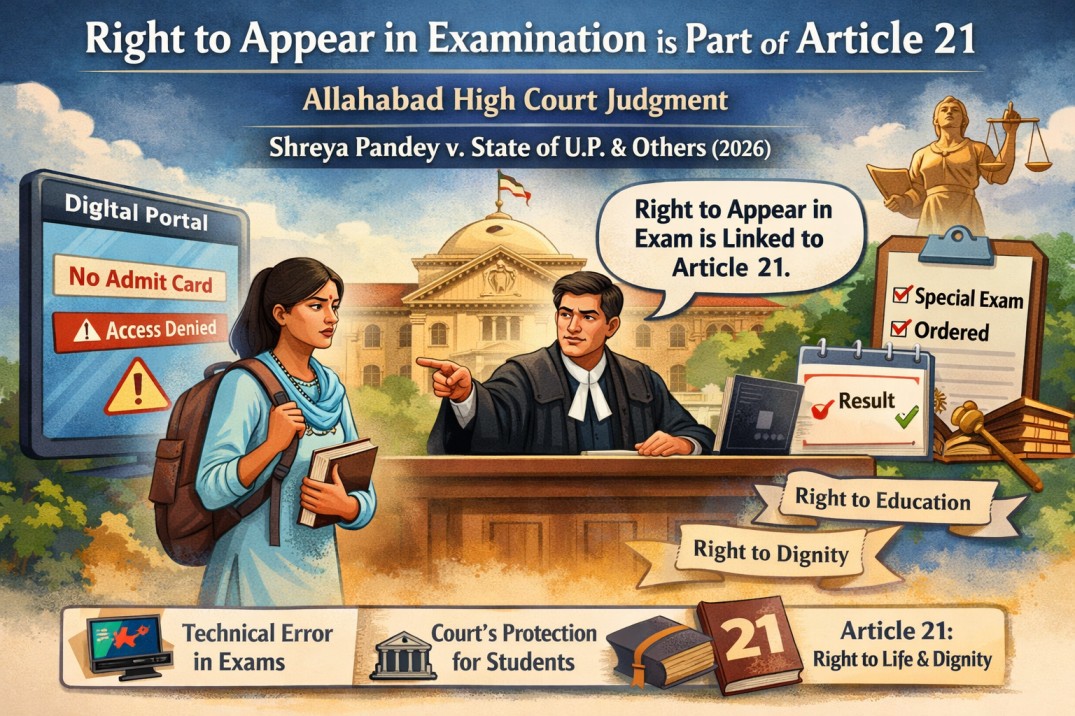 In January 2026, the Allahabad High Court delivered a significant decision in the writ petition titled Shreya Pandey vs. State of U.P. & 2 Others, addressing the fundamental rights of students under Article 21 of the Constitution of India—the right to life and personal liberty. The case arose from an administrative and technical glitch that prevented a student from appearing in her university examination.
Background of the Case
-
Petitioner: Shreya Pandey, a first-year B.Sc. (Biology) student at Urmila Devi PG College, Handia, affiliated with Rajju Bhaiya University in Prayagraj.
-
Respondents: State of U.P. and University authorities.
Facts:
-
Shreya had paid her tuition fees for the 2025–2026 academic session and attended regular classes. However, when the university published the examination schedule, she was not issued an admit card.
-
The reason was that her academic record was not updated on the university’s digital portal (‘Samarth Portal’) in time.
- Whether denying a student the right to appear in an examination due to a technical glitch or administrative lapse violates fundamental rights guaranteed under the Constitution, particularly Article 21 (Right to Life and Personal Liberty).
Petitioner’s Argument
-
She had fulfilled all formal requirements — fee payment and attendance — and that the failure to update her record was not due to any fault of hers.
-
The denial of the opportunity to sit for her examination jeopardized her academic future, which, in turn, affected her right to dignity and a meaningful life.
-
She argued that the right to appear in an academic examination was a necessary part of her fundamental rights, especially under Article 21.
Court’s Decision
The High Court issued the following mandatory interim directions:
-
The university was directed to conduct a special examination for Shreya for her B.Sc. (Biology) first semester within two weeks from the date of the order.
-
The university was ordered to publish her result within a reasonable period to ensure she can continue her studies without further disruption.
-
The university was also instructed to take all appropriate steps to update her academic records on the portal to secure her academic future.
-
The Court asked the University counsel to file a counter-affidavit detailing the procedure adopted when technical errors are brought to the University’s notice.
-
The court drew on its own earlier judgment — Rahul Pandey vs. Union of India (2025) — which had also recognized that appearing in an examination is a fundamental right under Article 21.
-
Additionally, it cited the Delhi High Court’s decision in Re: Master Prabhnoor Singh Virdi vs. Indian School and Another (2023), holding that depriving a student of examination opportunities is a violation of rights akin to Article 21.
Significance of the Judgment
परिचय
जनवरी 2026 में, इलाहाबाद उच्च न्यायालय ने श्रेया पांडे बनाम राज्य उत्तर प्रदेश एवं अन्य नामक रिट याचिका में एक महत्वपूर्ण निर्णय दिया। इस निर्णय में संविधान के अनुच्छेद 21 के अंतर्गत छात्रों के मौलिक अधिकारों—जीवन और व्यक्तिगत स्वतंत्रता के अधिकार—पर प्रकाश डाला गया। यह मामला एक प्रशासनिक और तकनीकी त्रुटि से उत्पन्न हुआ, जिसके कारण एक छात्रा को विश्वविद्यालय की परीक्षा में बैठने से वंचित कर दिया गया।
मामले की पृष्ठभूमि
पक्षकार
याचिकाकर्ता:
श्रेया पांडे, उर्मिला देवी पी.जी. कॉलेज, हंडिया (प्रयागराज) में बी.एससी. (जीवविज्ञान) प्रथम वर्ष की छात्रा, जो राजू भैया विश्वविद्यालय से संबद्ध है।
प्रतिवादी:
राज्य उत्तर प्रदेश एवं विश्वविद्यालय के अधिकारीगण।
तथ्य
-
श्रेया पांडे ने शैक्षणिक सत्र 2025–2026 के लिए अपनी पूरी फीस जमा कर दी थी और नियमित रूप से कक्षाओं में उपस्थित रही थी।
-
इसका कारण यह था कि विश्वविद्यालय के डिजिटल पोर्टल ‘समर्थ पोर्टल’ पर उनका शैक्षणिक रिकॉर्ड समय पर अपडेट नहीं किया गया था।
क्या केवल तकनीकी या प्रशासनिक त्रुटि के कारण किसी छात्र को परीक्षा में बैठने से रोकना संविधान द्वारा प्रदत्त अनुच्छेद 21 (जीवन और व्यक्तिगत स्वतंत्रता का अधिकार) का उल्लंघन है?
याचिकाकर्ता के तर्क
संविधान के अनुच्छेद 226 के अंतर्गत दायर रिट याचिका में श्रेया ने निम्नलिखित तर्क प्रस्तुत किए—
-
उन्होंने सभी आवश्यक औपचारिकताएँ पूरी की थीं, जैसे फीस का भुगतान और नियमित उपस्थिति, तथा रिकॉर्ड अपडेट न होना उनकी किसी गलती के कारण नहीं था।
-
परीक्षा में बैठने का अवसर न दिए जाने से उनका शैक्षणिक भविष्य खतरे में पड़ गया, जिससे उनके गरिमामय एवं सार्थक जीवन के अधिकार पर प्रतिकूल प्रभाव पड़ा।
-
उन्होंने यह भी तर्क दिया कि शैक्षणिक परीक्षा में सम्मिलित होने का अधिकार, विशेष रूप से अनुच्छेद 21 के अंतर्गत, उनके मौलिक अधिकारों का एक आवश्यक हिस्सा है।