WhatsApp Messages Alone Cannot Prove Murder: Supreme Court Acquits Man in Chhattisgarh Case
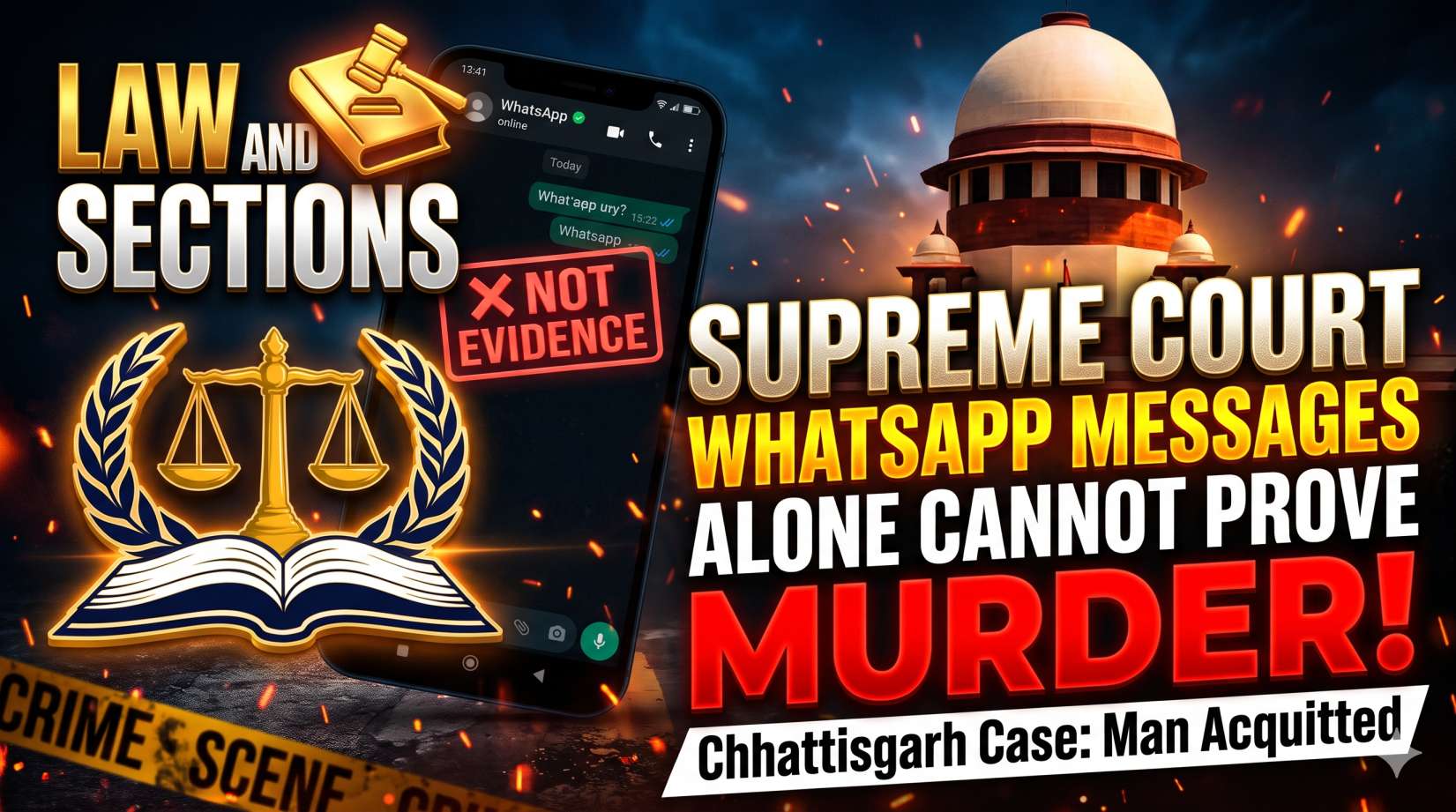
Summary (One Line): The Supreme Court acquitted a man convicted of murder, holding that a disputed WhatsApp message and an incomplete chain of circumstantial evidence were insufficient to establish guilt beyond reasonable doubt.
1. Why in News?
On 13 October 2026, the Supreme Court of India allowed the criminal appeal of Kusumlal Sao v. State of Chhattisgarh, set aside the conviction and acquitted the accused of all charges.
The Court held that a WhatsApp message whose sender and basis of knowledge were not reliably established could create suspicion, but could not independently prove that the accused had committed murder. The judgment has attracted attention because it explains how courts should evaluate digital messages and other circumstantial evidence in criminal trials.
Case details:
Case: Kusumlal Sao v. State of Chhattisgarh
Citation: 2026 INSC 1148
Case number: Criminal Appeal No. 4894 of 2026, arising out of SLP (Crl.) No. 11542 of 2026
Date of judgment: 13 October 2026
Bench: Justice Manoj Misra and Justice Vijay Bishnoi
Court: Supreme Court of India
2. Legal Issue
Can a person be convicted of murder primarily on the basis of a WhatsApp message when the alleged sender denies sending it, the witnesses do not support the prosecution's account, and the remaining circumstantial evidence does not establish guilt beyond reasonable doubt?
The Court also considered whether the message could be treated as part of the same transaction under Section 6 of the Indian Evidence Act, 1872, and whether the other evidence formed a complete chain pointing only towards the accused's guilt.
3. Full Story: How the Case Reached the Supreme Court
The case began in February 2019, when a man was found dead in an open field with a motorcycle nearby. The incident initially raised the possibility of an accident. Following the post-mortem examination, the police investigated it as a suspected murder.
The prosecution alleged that the accused, Kusumlal Sao, had assaulted the deceased during a quarrel at his house and that the body was subsequently found in the field. To establish its case, the prosecution relied on a WhatsApp message exchanged between two witnesses, the recovery of an iron rod and a screwdriver, blood-stained material, and injuries found on the accused.
The WhatsApp message, recovered through forensic examination of the witnesses' mobile phones, allegedly suggested that a fight had taken place between the accused and the deceased before the latter's death.
The Trial Court convicted the accused under Sections 302 and 201 of the Indian Penal Code, 1860, relating to murder and causing the disappearance of evidence. The Chhattisgarh High Court upheld the conviction. The accused then appealed to the Supreme Court.
The Supreme Court examined the evidence more closely. The two witnesses connected with the WhatsApp exchange did not establish that they had witnessed the alleged fight. One witness denied sending the incriminating message, while the other did not provide reliable testimony proving the accused's involvement.
The Court explained that proving a message was transmitted from one mobile phone to another does not automatically prove that its contents are true. It must also be established who authored the message, what the author actually knew, and whether the information was based on personal knowledge or hearsay.
The Court also considered the physical evidence. The blood-stained material could not be reliably linked to the deceased through DNA evidence. There were doubts about the place from which certain material had been recovered, and the possibility that the injuries resulted from a motorcycle accident could not be ruled out.
Another important question concerned Section 6 of the Indian Evidence Act, which deals with facts forming part of the same transaction. The Court found that the time of death had not been established by substantive evidence. Therefore, it was difficult to show that the WhatsApp exchange occurred at or about the time of the alleged offence so as to form part of the same transaction.
After considering the evidence as a whole, the Supreme Court concluded that the message created, at best, a suspicion and that the remaining circumstances did not complete the chain necessary to establish guilt.
The Court allowed the appeal, set aside the judgments of the Trial Court and High Court, and acquitted the accused of all charges. It directed his release unless he was required in another case.
The judgment does not mean that WhatsApp messages can never be used in criminal proceedings. It means that their reliability, relevance and connection with the alleged offence must be proved, and that a conviction cannot rest on suspicion in place of legally sufficient evidence.
4. Landmark Cases
1. Kusumlal Sao v. State of Chhattisgarh
Citation: 2026 INSC 1148; Criminal Appeal No. 4894 of 2026.
Principle: The Supreme Court held that a disputed WhatsApp message, whose authorship and factual basis were not established, could not sustain a murder conviction when the other circumstantial evidence was also insufficient.
2. Sharad Birdhichand Sarda v. State of Maharashtra
Citation: (1984) 4 SCC 116; AIR 1984 SC 1622; 1985 SCR (1) 88.
Principle: This leading judgment lays down the established principles for cases based on circumstantial evidence. The circumstances must be fully proved, consistent only with the guilt of the accused, conclusive in nature, and must form a complete chain that excludes reasonable alternative explanations.
Connection with the present case: The Supreme Court reiterated that suspicion, even if strong, cannot replace proof beyond reasonable doubt.
3. Hanumant Govind Nargundkar v. State of Madhya Pradesh
Citation: AIR 1952 SC 343; 1952 SCR 1091.
Principle: In a case based on circumstantial evidence, the circumstances must be fully established and must point towards the accused's guilt rather than leave a reasonable possibility consistent with innocence.
Connection with the present case: The WhatsApp message and the disputed recoveries did not establish a complete and reliable chain of circumstances.
4. Anvar P.V. v. P.K. Basheer
Citation: (2014) 10 SCC 473; AIR 2015 SC 180.
Principle: The Supreme Court explained the requirements governing the admissibility of electronic records under Section 65-B of the Indian Evidence Act, 1872, in cases where that provision applies.
Connection with the present case: Electronic records must satisfy the applicable legal requirements. Further, even when an electronic record is admissible, its contents and evidentiary value must still be assessed. Admissibility does not automatically prove the truth of every statement contained in a message.
5. Importance: Impact on the Common Citizen
This judgment is important because WhatsApp chats, screenshots and forwarded messages are commonly relied upon during disputes and investigations.
The ruling reinforces five practical principles:
A message is not automatically proof of its contents: The court must examine its source, reliability and connection with the alleged offence.
Digital evidence must be assessed carefully: The identity and knowledge of the sender may be crucial.
Suspicion is not enough: Criminal guilt must be established beyond reasonable doubt.
Every link matters: In a case based on circumstantial evidence, the prosecution must establish a complete and reliable chain.
The rights of the accused must be protected: A person cannot be convicted merely because a theory appears plausible or an electronic message seems incriminating.
The judgment does not make digital evidence irrelevant. It requires courts to examine digital evidence along with the entire body of evidence and apply the settled rules of criminal law.
6. Exam Snapshot: Judiciary and UPSC
Court: Supreme Court of India
Case: Kusumlal Sao v. State of Chhattisgarh
Citation: 2026 INSC 1148
Judgment date: 13 October 2026
Bench: Justice Manoj Misra and Justice Vijay Bishnoi
IPC Section 302: Punishment for murder.
IPC Section 201: Causing disappearance of evidence of an offence, or giving false information to screen an offender.
Indian Evidence Act, Section 6: Relevancy of facts forming part of the same transaction.
Indian Evidence Act, Section 7: Facts that are the occasion, cause or effect of facts in issue or relevant facts.
Indian Evidence Act, Section 65-B: Conditions relating to the admissibility of electronic records, where applicable.
Core principle: Suspicion, however strong, cannot replace proof beyond reasonable doubt.
Important case for circumstantial evidence: Sharad Birdhichand Sarda v. State of Maharashtra, (1984) 4 SCC 116; AIR 1984 SC 1622.
Exam takeaway: The existence or transmission of a WhatsApp message does not, by itself, prove the truth of its contents or establish criminal guilt. Courts must assess its reliability and the complete chain of evidence.
केवल WhatsApp संदेश के आधार पर हत्या की सजा नहीं दी जा सकती: सुप्रीम कोर्ट ने छत्तीसगढ़ के व्यक्ति को किया बरी
सारांश (एक लाइन में): सुप्रीम कोर्ट ने हत्या के एक मामले में आरोपी को बरी करते हुए कहा कि विवादित WhatsApp संदेश और परिस्थितिजन्य साक्ष्यों की अधूरी कड़ी से अपराध सिद्ध नहीं होता।
1. खबरों में क्यों?
13 अक्टूबर 2026 को भारत के सुप्रीम कोर्ट ने कुसुमलाल साव बनाम छत्तीसगढ़ राज्य (Kusumlal Sao v. State of Chhattisgarh) मामले में आरोपी की अपील स्वीकार की। कोर्ट ने निचली अदालतों के फैसलों को रद्द करते हुए आरोपी को सभी आरोपों से बरी कर दिया।
कोर्ट ने कहा कि जिस WhatsApp संदेश को अपराध से जोड़कर पेश किया गया था, उसके भेजने वाले और संदेश में दी गई जानकारी के आधार की विश्वसनीय पुष्टि नहीं हुई थी। ऐसा संदेश अधिकतम संदेह पैदा कर सकता है, लेकिन केवल उसके आधार पर हत्या का अपराध साबित नहीं किया जा सकता।
यह फैसला इसलिए महत्वपूर्ण है क्योंकि इसमें डिजिटल संदेशों और परिस्थितिजन्य साक्ष्यों की विश्वसनीयता पर विचार किया गया है।
मामले का विवरण:
मामला: Kusumlal Sao v. State of Chhattisgarh
साइटेशन: 2026 INSC 1148
केस नंबर: Criminal Appeal No. 4894 of 2026, जो SLP (Crl.) No. 11542 of 2026 से संबंधित है
फैसले की तारीख: 13 अक्टूबर 2026
पीठ: न्यायमूर्ति मनोज मिश्रा और न्यायमूर्ति विजय बिश्नोई
न्यायालय: भारत का सुप्रीम कोर्ट
2. कानूनी मुद्दा
क्या किसी व्यक्ति को मुख्य रूप से WhatsApp संदेश के आधार पर हत्या का दोषी ठहराया जा सकता है, जबकि कथित संदेश भेजने वाला उसे भेजने से इनकार कर दे, गवाह अभियोजन की कहानी का समर्थन न करें और बाकी परिस्थितिजन्य साक्ष्य भी अपराध को संदेह से परे साबित न करें?
कोर्ट के सामने यह सवाल भी था कि क्या इस संदेश को भारतीय साक्ष्य अधिनियम, 1872 की धारा 6 के तहत एक ही घटना या लेन-देन का हिस्सा माना जा सकता है। साथ ही, यह भी देखना था कि क्या बाकी साक्ष्य आरोपी के अपराध की ओर संकेत करने वाली पूरी कड़ी बनाते हैं।
3. पूरी कहानी: मामला सुप्रीम कोर्ट तक कैसे पहुँचा?
यह मामला फरवरी 2019 का है। एक व्यक्ति का शव खुले मैदान में मिला और उसके पास एक मोटरसाइकिल भी थी। शुरुआत में घटना के पीछे दुर्घटना की संभावना पर विचार किया गया। पोस्टमार्टम के बाद पुलिस ने मामले की जाँच संभावित हत्या के रूप में की।
अभियोजन पक्ष का आरोप था कि कुसुमलाल साव ने अपने घर पर मृतक के साथ हुए झगड़े के दौरान उस पर हमला किया था और बाद में मृतक का शव मैदान में मिला। इस आरोप को साबित करने के लिए अभियोजन ने दो गवाहों के बीच हुए WhatsApp संदेश, एक लोहे की रॉड, पेचकस, खून लगे सामान और आरोपी के शरीर पर मिली चोटों का सहारा लिया।
गवाहों के मोबाइल फोन की फॉरेंसिक जाँच में एक WhatsApp संदेश मिला। अभियोजन के अनुसार, उस संदेश से पता चलता था कि मृतक की मौत से पहले आरोपी और मृतक के बीच झगड़ा हुआ था।
ट्रायल कोर्ट ने भारतीय दंड संहिता, 1860 की धारा 302 और धारा 201 के तहत आरोपी को दोषी ठहराया। धारा 302 हत्या की सजा से संबंधित थी, जबकि धारा 201 अपराध के सबूत मिटाने या अपराधी को बचाने के लिए गलत जानकारी देने से संबंधित थी। छत्तीसगढ़ हाई कोर्ट ने भी सजा को बरकरार रखा। इसके बाद आरोपी ने सुप्रीम कोर्ट में अपील की।
सुप्रीम कोर्ट ने गवाहों के बयानों की बारीकी से जाँच की। WhatsApp संदेश से जुड़े दोनों गवाह यह साबित नहीं कर सके कि उन्होंने कथित झगड़ा अपनी आँखों से देखा था। एक गवाह ने संदेश भेजने से इनकार किया। दूसरे गवाह का बयान भी आरोपी की भूमिका को विश्वसनीय रूप से साबित नहीं कर पाया।
कोर्ट ने समझाया कि किसी मोबाइल फोन से दूसरे मोबाइल फोन पर संदेश भेजे जाने की पुष्टि हो जाने का अर्थ यह नहीं है कि संदेश में लिखी हर बात सच भी है। यह भी देखना जरूरी है कि संदेश किसने लिखा, उसे घटना के बारे में वास्तविक जानकारी थी या नहीं और उसकी जानकारी व्यक्तिगत अनुभव पर आधारित थी या सुनी-सुनाई बातों पर।
कोर्ट ने अन्य साक्ष्यों पर भी विचार किया। खून लगे सामान को डीएनए साक्ष्य के माध्यम से मृतक से विश्वसनीय रूप से नहीं जोड़ा जा सका। कुछ सामान कहाँ से बरामद हुआ, इस बारे में भी संदेह था। इसके अतिरिक्त, मोटरसाइकिल से गिरने के कारण दुर्घटना होने की संभावना को पूरी तरह खारिज नहीं किया जा सका।
कोर्ट ने भारतीय साक्ष्य अधिनियम की धारा 6 पर भी विचार किया। यह धारा एक ही घटना या लेन-देन का हिस्सा बनने वाले तथ्यों की प्रासंगिकता से संबंधित है। कोर्ट के अनुसार, ठोस साक्ष्य से मृत्यु का समय निश्चित नहीं किया गया था। इसलिए यह साबित करना कठिन था कि WhatsApp संदेश कथित अपराध के समय या उसके आसपास भेजा गया था और उसे उसी घटना का हिस्सा माना जा सकता था।
सभी साक्ष्यों को एक साथ देखने के बाद सुप्रीम कोर्ट ने पाया कि WhatsApp संदेश अधिकतम संदेह पैदा करता था। बाकी साक्ष्य भी आरोपी के अपराध को साबित करने वाली पूरी और विश्वसनीय कड़ी नहीं बनाते थे।
इसलिए सुप्रीम कोर्ट ने अपील स्वीकार की, ट्रायल कोर्ट और हाई कोर्ट के फैसलों को रद्द किया तथा आरोपी को सभी आरोपों से बरी कर दिया। कोर्ट ने निर्देश दिया कि यदि आरोपी किसी अन्य मामले में आवश्यक न हो, तो उसे रिहा किया जाए।
इस फैसले का अर्थ यह नहीं है कि आपराधिक मामलों में WhatsApp संदेश कभी साक्ष्य नहीं बन सकते। इसका अर्थ यह है कि संदेश की विश्वसनीयता, प्रासंगिकता और अपराध से उसका संबंध साबित करना जरूरी है। केवल संदेह के आधार पर किसी व्यक्ति को दोषी नहीं ठहराया जा सकता।
4. लैंडमार्क केस
1. Kusumlal Sao v. State of Chhattisgarh
साइटेशन: 2026 INSC 1148; Criminal Appeal No. 4894 of 2026.
सिद्धांत: सुप्रीम कोर्ट ने कहा कि जब WhatsApp संदेश भेजने वाले की पहचान और उसकी जानकारी का आधार साबित नहीं हो तथा अन्य परिस्थितिजन्य साक्ष्य भी पर्याप्त न हों, तो ऐसे संदेश के आधार पर हत्या की सजा कायम नहीं रखी जा सकती।
2. Sharad Birdhichand Sarda v. State of Maharashtra
साइटेशन: (1984) 4 SCC 116; AIR 1984 SC 1622; 1985 SCR (1) 88.
सिद्धांत: यह परिस्थितिजन्य साक्ष्यों से जुड़े मामलों का एक प्रमुख फैसला है। इसमें कहा गया कि सभी परिस्थितियाँ पूरी तरह साबित होनी चाहिए, उनका संबंध आरोपी के अपराध से होना चाहिए और वे मिलकर ऐसी पूरी कड़ी बनाएं जो निर्दोष होने की उचित संभावना को समाप्त करे।
वर्तमान मामले से संबंध: सुप्रीम कोर्ट ने फिर स्पष्ट किया कि संदेह कितना भी मजबूत क्यों न हो, वह संदेह से परे अपराध साबित करने का विकल्प नहीं हो सकता।
3. Hanumant Govind Nargundkar v. State of Madhya Pradesh
साइटेशन: AIR 1952 SC 343; 1952 SCR 1091.
सिद्धांत: परिस्थितिजन्य साक्ष्य वाले मामले में सभी परिस्थितियों को पूरी तरह साबित करना जरूरी है। उनसे आरोपी के अपराध का निष्कर्ष निकलना चाहिए और निर्दोष होने की उचित संभावना बाकी नहीं रहनी चाहिए।
वर्तमान मामले से संबंध: WhatsApp संदेश और विवादित बरामदगी आरोपी के अपराध की पूरी तथा विश्वसनीय कड़ी साबित नहीं कर सके।
4. Anvar P.V. v. P.K. Basheer
साइटेशन: (2014) 10 SCC 473; AIR 2015 SC 180.
सिद्धांत: सुप्रीम कोर्ट ने भारतीय साक्ष्य अधिनियम, 1872 की धारा 65-B के अंतर्गत इलेक्ट्रॉनिक रिकॉर्ड को साक्ष्य के रूप में स्वीकार करने की कानूनी शर्तों को समझाया।
वर्तमान मामले से संबंध: इलेक्ट्रॉनिक रिकॉर्ड को लागू कानूनी शर्तें पूरी करनी होती हैं। इसके अलावा, रिकॉर्ड स्वीकार कर लिए जाने के बाद भी उसकी सामग्री और विश्वसनीयता की जाँच जरूरी है। किसी संदेश का साक्ष्य के रूप में स्वीकार होना अपने आप यह साबित नहीं करता कि उसमें लिखी हर बात सच है।
5. महत्व: आम नागरिक पर क्या असर पड़ेगा?
आज WhatsApp चैट, स्क्रीनशॉट और फॉरवर्ड किए गए संदेशों का इस्तेमाल विवादों तथा पुलिस जाँच में आम है। इस फैसले से कुछ महत्वपूर्ण बातें समझ आती हैं:
संदेश में लिखी बात अपने आप सच नहीं हो जाती: कोर्ट को उसके स्रोत, विश्वसनीयता और अपराध से संबंध की जाँच करनी चाहिए।
डिजिटल साक्ष्य की सावधानी से जाँच जरूरी है: संदेश भेजने वाले की पहचान और उसे जानकारी कैसे मिली, यह महत्वपूर्ण हो सकता है।
सिर्फ संदेह पर्याप्त नहीं है: आपराधिक मामले में अपराध संदेह से परे साबित होना चाहिए।
साक्ष्यों की पूरी कड़ी जरूरी है: परिस्थितिजन्य साक्ष्य वाले मामले में अभियोजन को सभी जरूरी कड़ियाँ साबित करनी होती हैं।
आरोपी के अधिकारों की रक्षा जरूरी है: केवल किसी कहानी के सही लगने या संदेश के आपत्तिजनक दिखने से किसी को दोषी नहीं ठहराया जा सकता।
यह फैसला डिजिटल साक्ष्य को महत्वहीन नहीं बनाता। यह बताता है कि डिजिटल साक्ष्य को अन्य सभी साक्ष्यों के साथ देखकर कानून के स्थापित सिद्धांतों के अनुसार परखा जाना चाहिए।
6. परीक्षा के लिए मुख्य बिंदु: Judiciary और UPSC
न्यायालय: भारत का सुप्रीम कोर्ट
मामला: Kusumlal Sao v. State of Chhattisgarh
साइटेशन: 2026 INSC 1148
फैसले की तारीख: 13 अक्टूबर 2026
पीठ: न्यायमूर्ति मनोज मिश्रा और न्यायमूर्ति विजय बिश्नोई
भारतीय दंड संहिता, धारा 302: हत्या के लिए दंड।
भारतीय दंड संहिता, धारा 201: अपराध के साक्ष्य मिटाना या अपराधी को बचाने के लिए गलत जानकारी देना।
भारतीय साक्ष्य अधिनियम, धारा 6: एक ही घटना या लेन-देन का हिस्सा बनने वाले तथ्यों की प्रासंगिकता।
भारतीय साक्ष्य अधिनियम, धारा 7: विवादित तथ्य या प्रासंगिक तथ्यों के अवसर, कारण या परिणाम से जुड़े तथ्यों की प्रासंगिकता।
भारतीय साक्ष्य अधिनियम, धारा 65-B: लागू होने की स्थिति में इलेक्ट्रॉनिक रिकॉर्ड को साक्ष्य के रूप में स्वीकार करने की शर्तें।
मुख्य सिद्धांत: मजबूत संदेह भी संदेह से परे अपराध साबित करने का विकल्प नहीं है।
परिस्थितिजन्य साक्ष्य का प्रमुख मामला: Sharad Birdhichand Sarda v. State of Maharashtra, (1984) 4 SCC 116; AIR 1984 SC 1622.
परीक्षा के लिए याद रखें: WhatsApp संदेश का अस्तित्व या उसका भेजा जाना अपने आप उसकी सामग्री की सच्चाई या आरोपी का अपराध साबित नहीं करता। कोर्ट को संदेश की विश्वसनीयता और पूरे साक्ष्य की कड़ी का मूल्यांकन करना चाहिए।