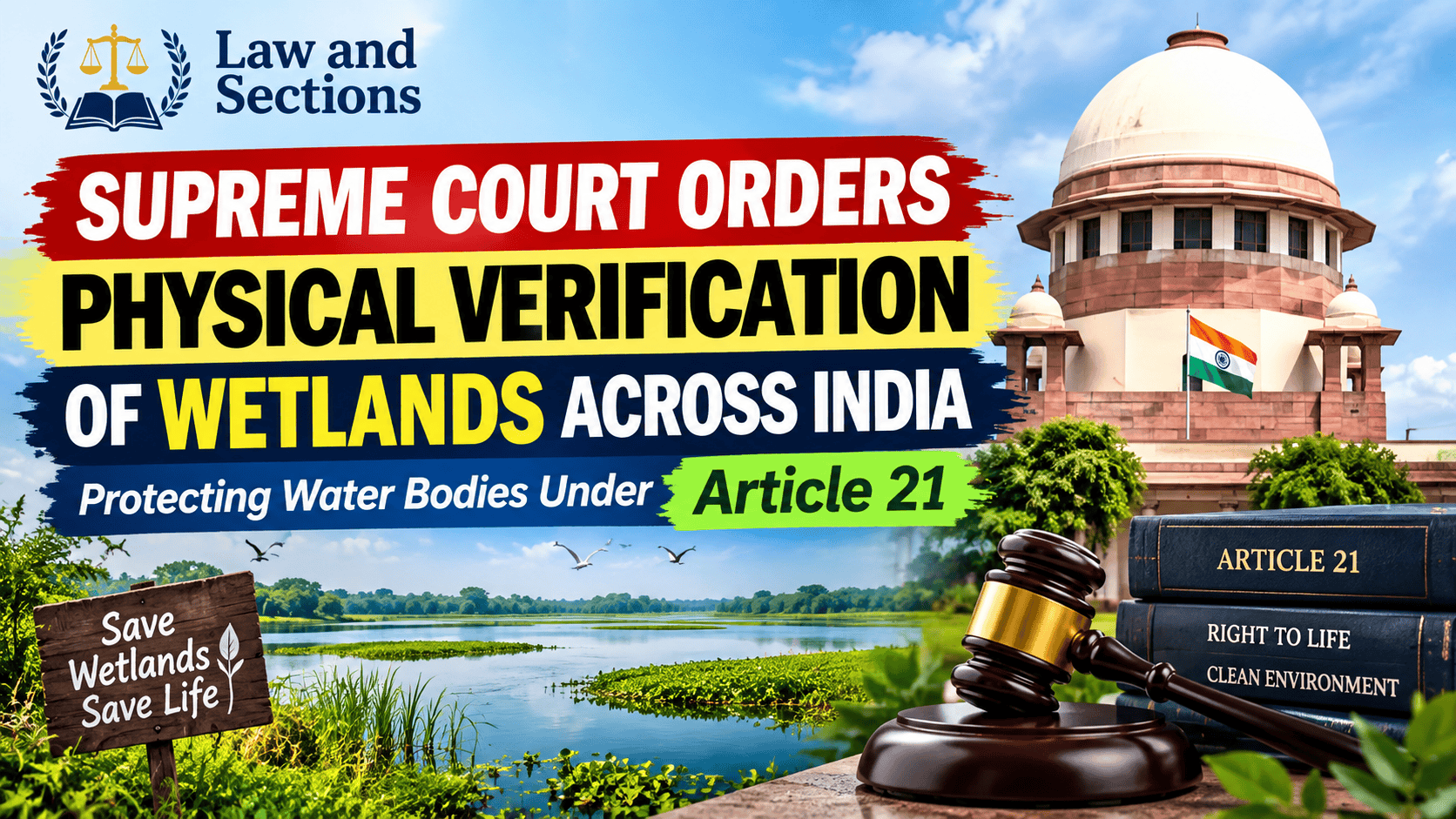
Supreme Court Orders Physical Verification of Wetlands Across India: Protecting Water Bodies Under Article 21
1. Summary (1-Line)
The Supreme Court has directed states and Wetland Authorities to physically verify and demarcate wetlands and other water bodies, submit compliance affidavits within four weeks, and complete the exercise within four months, emphasising the importance of protecting water resources under Article 21 of the Constitution.
2. Why in News?
On 24 October 2026, Telangana Today published a report stating that the Supreme Court had reiterated its directions for the physical verification and demarcation of wetlands across states.
According to the report, a Bench comprising Justice Aravind Kumar and Justice Vipul M. Pancholi emphasised that water bodies are precious resources because they provide drinking water and are connected with the right to life under Article 21.
The reported directions require:
States and Wetland Authorities to submit compliance affidavits within four weeks.
Physical verification and demarcation to be completed within four months.
Authorities to explain the method and progress of the exercise.
Verification to be conducted physically on the ground rather than being treated as a paperwork exercise.
The report also highlights concern about delays in implementing the Wetlands (Conservation and Management) Rules, 2017.
Date clarification: The reported order date is 12 October 2026, whereas the news article was published on 24 October 2026. These are separate dates.
3. Key Legal Question (Analytical)
How can the State effectively protect wetlands and other water bodies if their actual existence, condition and boundaries are not verified on the ground?
This is an analytical question arising from the proceedings, not a question quoted verbatim from the Supreme Court's order.
The main legal principles involved are:
Article 21: Protection of life, including interests connected with safe drinking water and a healthy environment.
Article 48A: The State's duty to protect and improve the environment.
Article 51A(g): The fundamental duty of citizens to protect and improve the natural environment.
Environment (Protection) Act, 1986: The statutory framework for environmental protection.
Wetlands (Conservation and Management) Rules, 2017: The framework for identifying, conserving and managing wetlands.
4. Full Story
Imagine a village pond that has supplied water to local residents for generations. It supports agriculture, birds, aquatic life and groundwater recharge. Over time, however, parts of the pond may be filled with soil, its boundaries may become unclear, or nearby construction may encroach upon it.
The pond may still appear in government records, but those records may not accurately reflect its actual condition. This illustrates why physical verification is important.
Background of the proceedings
The Supreme Court has considered the issue of wetland identification and conservation in connected proceedings, including Anand Arya v. Union of India, Writ Petition (Civil) No. 304 of 2018, along with W.P. (C) Nos. 230 of 2001 and 302 of 2020.
On 11 December 2024, the Court directed State and Union Territory Wetland Authorities to undertake ground-truthing and demarcation of wetlands identified in the Space Applications Centre Atlas, 2021.
The order explained that ground-truthing involves actual inspection of wetlands by a team constituted by the State. The Court treated this exercise as a statutory responsibility of the relevant authorities under the applicable framework.
The earlier order also recorded that the ISRO-related figures for wetlands exceeding 2.25 hectares had increased from 201,503 in earlier data to 231,195 in the 2021 data. These figures were cited to explain the scale of the task.
What is ground-truthing?
Ground-truthing means physically visiting a location to check whether maps and official records match the actual situation.
For a wetland, this can involve identifying its location, examining its boundaries and comparing the findings with available land records and mapping data.
Demarcation means determining and marking the boundaries of the wetland. These steps can help authorities identify encroachments, document the actual extent of water bodies and plan appropriate conservation measures.
What has the Court directed?
According to the report published on 24 October 2026, the Supreme Court reiterated the need for physical verification of wetlands and other water bodies.
States and Wetland Authorities have reportedly been directed to submit compliance affidavits within four weeks and complete the exercise within four months. Their affidavits must explain the method adopted and the status of implementation.
The Court recognised that the exercise requires substantial fieldwork and coordination between government departments. Nevertheless, the importance of water bodies makes timely implementation necessary.
The exact wording and scope of the 12 October 2026 order, including the next hearing date, should be checked against the original judicial order before publication as a verified legal update.
Why is the decision important?
Water bodies contribute to drinking-water security, groundwater recharge, biodiversity and flood management. Their degradation can affect public health, agriculture and local livelihoods.
The constitutional connection is important because environmental protection is not merely an administrative task. It may also concern rights protected under Article 21.
The central lesson is that environmental protection requires implementation, monitoring and reliable information. Recording a wetland in a document is not a substitute for verifying its actual location, boundaries and condition.
5. Landmark Cases
1. M.C. Mehta v. Kamal Nath
Citation: (1997) 1 SCC 388.
Principle: Public Trust Doctrine.
The Supreme Court applied the Public Trust Doctrine in the context of the protection of natural resources and the River Beas. The State holds certain natural resources in trust for public use and cannot permit their misuse contrary to public interest.
Relevance: This principle supports the responsibility of public authorities to protect important natural resources, including water bodies.
2. Vellore Citizens' Welfare Forum v. Union of India
Citation: (1996) 5 SCC 647.
Principles: Precautionary Principle and Polluter Pays Principle.
The Supreme Court recognised these principles as essential features of environmental law in India. Preventive action may be necessary where serious environmental risks exist, and those responsible for pollution may be required to bear the costs of preventing and remedying environmental damage.
Relevance: Physical verification can help authorities identify environmental risks and take appropriate preventive measures.
3. Hinch Lal Tiwari v. Kamala Devi
Citation: (2001) 6 SCC 496.
Principle: Protection of village ponds and community resources.
The Supreme Court emphasised the importance of preserving village ponds and community resources for public use. It disapproved of the allotment of pond land for purposes inconsistent with its public and ecological value.
Relevance: This judgment is particularly relevant when village ponds face encroachment or conversion to non-water uses.
4. Intellectuals Forum, Tirupathi v. State of Andhra Pradesh
Citation: (2006) 3 SCC 549.
Principles: Public Trust Doctrine, sustainable development and environmental protection.
The Supreme Court considered the protection of public water bodies in the context of development. The judgment emphasises that development decisions must take account of environmental interests and the public importance of natural resources.
Relevance: Authorities should consider ecological and community interests before permitting activities that affect water bodies.
Citation caution: These four judgments establish relevant environmental-law principles. They are not the same proceeding as the current wetland-verification litigation. The present proceedings are identified as Anand Arya v. Union of India, W.P. (C) No. 304 of 2018, connected with W.P. (C) Nos. 230 of 2001 and 302 of 2020. A verified AIR or SCC citation for the specific reported order dated 12 October 2026 has not been established here.
6. Importance for the Common Citizen
Drinking water: Protecting water bodies supports local water security.
Groundwater: Healthy wetlands can contribute to groundwater recharge.
Flood management: Wetlands can store excess rainwater and help reduce flooding in suitable conditions.
Prevention of encroachment: Clear boundaries make unauthorised occupation easier to identify.
Biodiversity: Wetlands support birds, fish and other wildlife.
Accountability: Compliance affidavits require authorities to report the status of their work.
The order should not be interpreted to mean that every water body automatically receives identical legal protection under every statute. The applicable protection depends on the relevant law, rules, notifications and facts.
7. Exam Snapshot: Judiciary and UPSC
Constitutional provisions
Article 21 — Right to Life.
Article 48A — Protection and improvement of the environment.
Article 51A(g) — Fundamental duty to protect the natural environment.
Relevant legislation
Environment (Protection) Act, 1986.
Wetlands (Conservation and Management) Rules, 2017.
Connected proceedings: Anand Arya v. Union of India, W.P. (C) No. 304 of 2018, connected with W.P. (C) Nos. 230 of 2001 and 302 of 2020.
One-line takeaway: The Supreme Court's reported directions emphasise physical verification and demarcation as essential steps towards effective wetland conservation, with environmental protection connected to Article 21.
1. शीर्षक
सुप्रीम कोर्ट का निर्देश: देशभर की आर्द्रभूमियों की होगी भौतिक जाँच, अनुच्छेद 21 से जुड़ा जल निकायों का संरक्षण
आदेश की तारीख: 12 अक्टूबर 2026 (समाचार रिपोर्ट के अनुसार)
समाचार प्रकाशन की तारीख: 24 अक्टूबर 2026
विषय: पर्यावरण कानून | संवैधानिक कानून | न्यायिक सेवा एवं UPSC
2. सारांश (एक लाइन में)
सर्वोच्च न्यायालय ने राज्यों और आर्द्रभूमि प्राधिकरणों को आर्द्रभूमियों तथा अन्य जल निकायों की वास्तविक स्थिति की जाँच करके उनकी सीमाएँ निर्धारित करने का निर्देश दिया है। रिपोर्ट के अनुसार, अनुपालन शपथपत्र चार सप्ताह में दाखिल करने और पूरी जाँच चार महीने में समाप्त करने को कहा गया है। न्यायालय ने जल संसाधनों के संरक्षण को संविधान के अनुच्छेद 21 के अंतर्गत जीवन के अधिकार से जोड़ा है।
3. खबरों में क्यों?
24 अक्टूबर 2026 को Telangana Today ने एक समाचार प्रकाशित किया, जिसके अनुसार सर्वोच्च न्यायालय ने देशभर में आर्द्रभूमियों की वास्तविक जाँच और उनकी सीमाएँ निर्धारित करने के अपने निर्देश दोहराए।
समाचार रिपोर्ट के अनुसार, न्यायमूर्ति अरविंद कुमार और न्यायमूर्ति विपुल एम. पंचोली की पीठ ने कहा कि जल निकाय महत्वपूर्ण प्राकृतिक संसाधन हैं, क्योंकि वे पीने का पानी उपलब्ध कराते हैं। इसलिए उनका संरक्षण संविधान के अनुच्छेद 21 के अंतर्गत जीवन के अधिकार से जुड़ा है।
रिपोर्ट में बताए गए निर्देशों के अनुसार:
राज्यों और आर्द्रभूमि प्राधिकरणों को चार सप्ताह में अनुपालन शपथपत्र दाखिल करना होगा।
भौतिक जाँच और सीमा-निर्धारण का कार्य चार महीने में पूरा करना होगा।
अधिकारियों को अपनाई गई प्रक्रिया और कार्य की प्रगति की जानकारी देनी होगी।
जाँच जमीन पर जाकर की जानी चाहिए, केवल कागजी कार्रवाई के रूप में नहीं।
रिपोर्ट में आर्द्रभूमि (संरक्षण एवं प्रबंधन) नियम, 2017 के क्रियान्वयन में हुई देरी पर भी चिंता व्यक्त की गई है।
तारीख का स्पष्टीकरण: रिपोर्ट के अनुसार आदेश की तारीख 12 अक्टूबर 2026 है, जबकि समाचार 24 अक्टूबर 2026 को प्रकाशित हुआ। ये दोनों अलग-अलग तारीखें हैं।
4. मुख्य कानूनी प्रश्न (विश्लेषणात्मक)
यदि आर्द्रभूमियों और अन्य जल निकायों की वास्तविक स्थिति, अस्तित्व और सीमाओं की जमीन पर जाँच नहीं की जाती, तो राज्य उनका प्रभावी संरक्षण कैसे सुनिश्चित कर सकता है?
यह न्यायालय की कार्यवाही से उत्पन्न एक विश्लेषणात्मक प्रश्न है। इसे सर्वोच्च न्यायालय के आदेश में शब्दशः लिखे गए प्रश्न के रूप में प्रस्तुत नहीं किया जाना चाहिए।
इस मामले में मुख्य कानूनी सिद्धांत हैं:
अनुच्छेद 21: जीवन का अधिकार, जिसमें सुरक्षित पेयजल और स्वस्थ पर्यावरण से जुड़े हित शामिल हैं।
अनुच्छेद 48A: पर्यावरण की रक्षा और सुधार करना राज्य का कर्तव्य है।
अनुच्छेद 51A(g): प्राकृतिक पर्यावरण की रक्षा करना नागरिकों का मौलिक कर्तव्य है।
पर्यावरण (संरक्षण) अधिनियम, 1986: पर्यावरण संरक्षण का वैधानिक ढाँचा।
आर्द्रभूमि (संरक्षण एवं प्रबंधन) नियम, 2017: आर्द्रभूमियों की पहचान, संरक्षण और प्रबंधन से संबंधित व्यवस्था।
5. पूरी कहानी
कल्पना कीजिए कि किसी गाँव में एक पुराना तालाब है, जो पीढ़ियों से लोगों को पानी उपलब्ध कराता रहा है। यह तालाब खेती, पक्षियों, जलीय जीवों और भूजल के पुनर्भरण में भी मदद करता है। लेकिन समय के साथ तालाब के कुछ हिस्सों में मिट्टी भर सकती है, उसकी सीमाएँ अस्पष्ट हो सकती हैं या आसपास निर्माण करके उसकी जमीन पर कब्जा किया जा सकता है।
सरकारी रिकॉर्ड में तालाब का नाम अब भी दर्ज हो सकता है, लेकिन रिकॉर्ड उसकी वास्तविक स्थिति को सही ढंग से नहीं दर्शाते हों। यही कारण है कि जल निकायों की भौतिक जाँच आवश्यक है।
मामले की पृष्ठभूमि
सर्वोच्च न्यायालय में आर्द्रभूमियों की पहचान और संरक्षण से संबंधित कई जुड़ी हुई कार्यवाहियाँ हुई हैं। इनमें Anand Arya v. Union of India, रिट याचिका (सिविल) संख्या 304/2018 तथा संबंधित याचिका संख्या 230/2001 और 302/2020 शामिल हैं।
11 दिसंबर 2024 को न्यायालय ने राज्यों और केंद्रशासित प्रदेशों के आर्द्रभूमि प्राधिकरणों को अंतरिक्ष अनुप्रयोग केंद्र द्वारा तैयार आर्द्रभूमि एटलस, 2021 में पहचानी गई आर्द्रभूमियों की वास्तविक जाँच और सीमा-निर्धारण करने का निर्देश दिया था।
उस आदेश में बताया गया कि वास्तविक जाँच का अर्थ राज्य द्वारा गठित टीम के माध्यम से आर्द्रभूमियों का मौके पर निरीक्षण करना है। न्यायालय ने इसे संबंधित प्राधिकरणों की वैधानिक जिम्मेदारी माना।
पूर्व आदेश में 2.25 हेक्टेयर से अधिक क्षेत्रफल वाली आर्द्रभूमियों के संबंध में ISRO से जुड़े आँकड़ों का भी उल्लेख किया गया था। पहले के आँकड़ों में ऐसी आर्द्रभूमियों की संख्या 2,01,503 थी, जबकि 2021 के आँकड़ों में यह संख्या 2,31,195 बताई गई। इन आँकड़ों से कार्य की व्यापकता का पता चलता है।
वास्तविक जाँच क्या होती है?
वास्तविक जाँच का अर्थ है किसी स्थान पर जाकर यह पता लगाना कि नक्शों और सरकारी रिकॉर्ड में दी गई जानकारी जमीन की वास्तविक स्थिति से मेल खाती है या नहीं।
आर्द्रभूमि के मामले में इसमें उसका वास्तविक स्थान पहचानना, सीमाओं का निरीक्षण करना और उपलब्ध भूमि रिकॉर्ड तथा नक्शों से जानकारी का मिलान करना शामिल हो सकता है।
सीमा-निर्धारण का अर्थ है आर्द्रभूमि की वास्तविक सीमाओं को तय करना और उन्हें चिह्नित करना। इससे अवैध कब्जों की पहचान करने, जल निकायों का वास्तविक क्षेत्रफल दर्ज करने और उचित संरक्षण उपाय तैयार करने में मदद मिल सकती है।
न्यायालय ने क्या निर्देश दिए?
24 अक्टूबर 2026 को प्रकाशित समाचार के अनुसार, सर्वोच्च न्यायालय ने आर्द्रभूमियों और अन्य जल निकायों की भौतिक जाँच की आवश्यकता पर फिर जोर दिया।
रिपोर्ट के अनुसार, राज्यों और आर्द्रभूमि प्राधिकरणों को चार सप्ताह में अनुपालन शपथपत्र दाखिल करना होगा और चार महीने में जाँच पूरी करनी होगी। शपथपत्र में अपनाई गई प्रक्रिया और कार्य की स्थिति का विवरण देना होगा।
न्यायालय ने माना कि इस कार्य के लिए बड़े स्तर पर जमीनी निरीक्षण और विभिन्न सरकारी विभागों के बीच तालमेल आवश्यक है। फिर भी, जल निकायों के महत्व को देखते हुए इस कार्य को समय पर पूरा करना जरूरी है।
12 अक्टूबर 2026 के आदेश की सटीक भाषा और उसका पूरा दायरा, जिसमें अगली सुनवाई की तारीख भी शामिल है, प्रकाशित करने से पहले मूल न्यायिक आदेश से सत्यापित किया जाना चाहिए।
यह निर्णय क्यों महत्वपूर्ण है?
जल निकाय पीने के पानी की उपलब्धता, भूजल के पुनर्भरण, जैव विविधता और बाढ़ प्रबंधन में महत्वपूर्ण भूमिका निभाते हैं। इनके नष्ट होने से सार्वजनिक स्वास्थ्य, खेती और स्थानीय लोगों की आजीविका प्रभावित हो सकती है।
इस मामले में अनुच्छेद 21 का महत्व इसलिए है, क्योंकि पर्यावरण संरक्षण केवल प्रशासनिक कार्य नहीं है। इसका संबंध संविधान द्वारा संरक्षित अधिकारों से भी हो सकता है।
इस मामले का मुख्य संदेश है कि पर्यावरण संरक्षण के लिए कानून बनाना ही पर्याप्त नहीं है। कानून को लागू करना, कार्य की निगरानी करना और सही जानकारी उपलब्ध रखना भी जरूरी है। किसी आर्द्रभूमि का नाम सरकारी रिकॉर्ड में दर्ज होना उसकी वास्तविक स्थिति और सीमाओं की जाँच का विकल्प नहीं हो सकता।
6. लैंडमार्क केस
1. एम.सी. मेहता बनाम कमल नाथ
साइटेशन: (1997) 1 SCC 388।
सिद्धांत: सार्वजनिक न्यास का सिद्धांत।
सर्वोच्च न्यायालय ने प्राकृतिक संसाधनों और ब्यास नदी के संरक्षण के संदर्भ में सार्वजनिक न्यास के सिद्धांत को लागू किया। राज्य कुछ प्राकृतिक संसाधनों को जनता के हित में सुरक्षित रखने के लिए जिम्मेदार है। वह सार्वजनिक हित के विरुद्ध इन संसाधनों के दुरुपयोग की अनुमति नहीं दे सकता।
वर्तमान मामले से संबंध: यह सिद्धांत जल निकायों सहित महत्वपूर्ण प्राकृतिक संसाधनों के संरक्षण की सार्वजनिक प्राधिकरणों की जिम्मेदारी को समझने में मदद करता है।
2. वेल्लोर सिटिजन्स वेलफेयर फोरम बनाम भारत संघ
साइटेशन: (1996) 5 SCC 647।
सिद्धांत: सावधानी का सिद्धांत और प्रदूषण करने वाला भुगतान करेगा का सिद्धांत।
सर्वोच्च न्यायालय ने इन सिद्धांतों को भारतीय पर्यावरण कानून के महत्वपूर्ण हिस्सों के रूप में स्वीकार किया। गंभीर पर्यावरणीय जोखिम होने पर रोकथाम के लिए कदम उठाए जा सकते हैं। प्रदूषण के लिए जिम्मेदार व्यक्ति या संस्था को पर्यावरणीय नुकसान रोकने और उसकी भरपाई करने की लागत वहन करनी पड़ सकती है।
वर्तमान मामले से संबंध: जल निकायों की भौतिक जाँच से पर्यावरणीय जोखिमों की पहचान करने और उचित रोकथाम के उपाय करने में सहायता मिल सकती है।
3. हिन्च लाल तिवारी बनाम कमला देवी
साइटेशन: (2001) 6 SCC 496।
सिद्धांत: गाँव के तालाबों और सामुदायिक संसाधनों का संरक्षण।
सर्वोच्च न्यायालय ने गाँव के तालाबों और सामुदायिक संसाधनों को जनता के उपयोग के लिए सुरक्षित रखने के महत्व पर जोर दिया। न्यायालय ने तालाब की जमीन को ऐसे उद्देश्यों के लिए आवंटित करने को अनुचित माना, जो उसके सार्वजनिक उपयोग और पर्यावरणीय महत्व के विपरीत हों।
वर्तमान मामले से संबंध: यह निर्णय उन गाँवों के तालाबों के लिए विशेष रूप से महत्वपूर्ण है, जिन पर अवैध कब्जे किए जा रहे हों या जिन्हें अन्य उपयोगों में बदला जा रहा हो।
4. इंटेलेक्चुअल्स फोरम, तिरुपति बनाम आंध्र प्रदेश राज्य
साइटेशन: (2006) 3 SCC 549।
सिद्धांत: सार्वजनिक न्यास का सिद्धांत, सतत विकास और पर्यावरण संरक्षण।
सर्वोच्च न्यायालय ने विकास कार्यों के संदर्भ में सार्वजनिक जल निकायों के संरक्षण पर विचार किया। इस निर्णय का मुख्य संदेश है कि विकास संबंधी निर्णय लेते समय पर्यावरण और प्राकृतिक संसाधनों के सार्वजनिक महत्व को ध्यान में रखना चाहिए।
वर्तमान मामले से संबंध: जल निकायों को प्रभावित करने वाली गतिविधियों की अनुमति देने से पहले अधिकारियों को पर्यावरणीय और सामुदायिक हितों पर विचार करना चाहिए।
साइटेशन संबंधी सावधानी: ये चारों निर्णय पर्यावरण कानून के स्थापित सिद्धांतों से संबंधित हैं। ये वर्तमान आर्द्रभूमि-जाँच कार्यवाही से अलग मामले हैं। वर्तमान कार्यवाही की पहचान Anand Arya v. Union of India, W.P. (C) No. 304 of 2018 तथा संबंधित W.P. (C) Nos. 230 of 2001 और 302 of 2020 के रूप में है। 12 अक्टूबर 2026 के विशिष्ट आदेश का सत्यापित AIR या SCC साइटेशन यहाँ स्थापित नहीं है।
7. आम नागरिक के लिए महत्व
पीने का पानी: जल निकायों का संरक्षण स्थानीय जल संसाधनों की सुरक्षा में मदद करता है।
भूजल: स्वस्थ आर्द्रभूमियाँ भूजल के पुनर्भरण में सहायता कर सकती हैं।
बाढ़ प्रबंधन: उपयुक्त परिस्थितियों में आर्द्रभूमियाँ वर्षा के अतिरिक्त पानी को रोककर बाढ़ का प्रभाव कम कर सकती हैं।
अवैध कब्जों की रोकथाम: स्पष्ट सीमाएँ निर्धारित होने से अनधिकृत कब्जों की पहचान करना आसान होता है।
जैव विविधता: आर्द्रभूमियाँ पक्षियों, मछलियों और अन्य वन्यजीवों को आवास प्रदान करती हैं।
सरकारी जवाबदेही: अनुपालन शपथपत्रों से अधिकारियों को अपने कार्य की स्थिति बतानी पड़ती है।
इस आदेश का अर्थ यह नहीं है कि प्रत्येक जल निकाय को सभी कानूनों के अंतर्गत स्वतः समान कानूनी संरक्षण मिल जाता है। उसका संरक्षण संबंधित कानून, नियमों, अधिसूचनाओं और मामले के तथ्यों पर निर्भर करेगा।
8. परीक्षा के लिए मुख्य बिंदु: Judiciary और UPSC
संवैधानिक प्रावधान
अनुच्छेद 21 — जीवन का अधिकार।
अनुच्छेद 48A — पर्यावरण की रक्षा और सुधार।
अनुच्छेद 51A(g) — प्राकृतिक पर्यावरण की रक्षा करना मौलिक कर्तव्य।
प्रमुख कानून
पर्यावरण (संरक्षण) अधिनियम, 1986।
आर्द्रभूमि (संरक्षण एवं प्रबंधन) नियम, 2017।
संबंधित कार्यवाही: Anand Arya v. Union of India, W.P. (C) No. 304 of 2018, संबंधित W.P. (C) Nos. 230 of 2001 और 302 of 2020 के साथ।
परीक्षा के लिए एक लाइन: सर्वोच्च न्यायालय के रिपोर्ट किए गए निर्देशों के अनुसार, आर्द्रभूमियों का प्रभावी संरक्षण सुनिश्चित करने के लिए उनकी वास्तविक जाँच और सीमाओं का निर्धारण आवश्यक है। यह संरक्षण संविधान के अनुच्छेद 21 के अंतर्गत जीवन के अधिकार से जुड़ा है।