POCSO Case Against Teacher Quashed: Supreme Court Holds Corporal Punishment Without Sexual Intent Does Not Constitute Sexual Assault
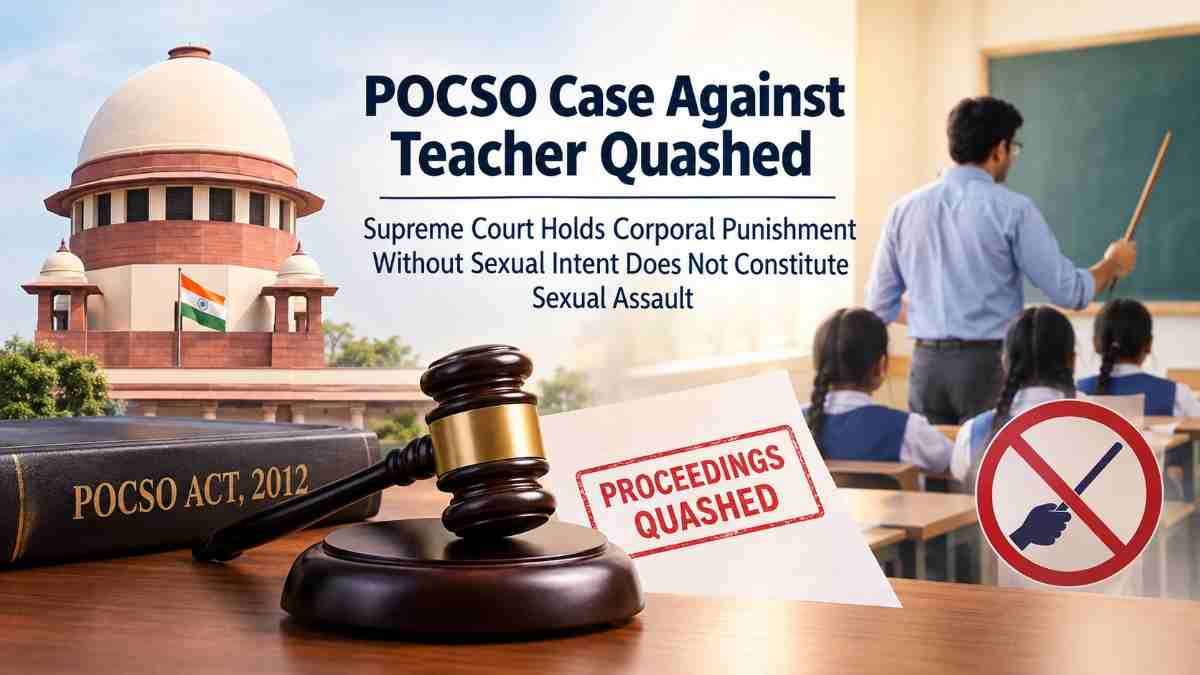
The Supreme Court has quashed POCSO proceedings against a West Bengal school teacher, holding that inappropriate corporal punishment, in the absence of the required sexual intent, does not constitute sexual assault under the POCSO Act.
Why in News
The Supreme Court recently decided Bhaskar Paul v. State of West Bengal, concerning a school teacher who was prosecuted under Section 10 of the Protection of Children from Sexual Offences Act, 2012 (POCSO Act).
A Bench comprising Justice Ujjal Bhuyan and Justice Atul S. Chandurkar quashed the proceedings, finding that the material placed before the Court did not disclose the sexual intent required under Section 7 of the POCSO Act. The judgment was passed on 8 September 2026 and has attracted attention because it explains the boundary between improper corporal punishment and conduct that legally amounts to sexual assault under POCSO.
Legal Issue
Whether physical touching or corporal punishment by a teacher, without the necessary sexual intent, can constitute “sexual assault” under Section 7 and “aggravated sexual assault” under Section 10 of the POCSO Act?
The Supreme Court answered this question in the negative on the facts of the case.
Section 7 of the POCSO Act requires sexual intent for an act involving physical contact to amount to sexual assault. Section 9(f) deals with aggravated sexual assault committed by a person on the management or staff of an educational institution, while Section 10 prescribes the punishment for aggravated sexual assault.
Background
The case began with allegations concerning a school teacher, Bhaskar Paul, who taught at a school in Alipurduar, West Bengal.
According to the material placed before the Court, complaints were made regarding the teacher's conduct towards female students. The allegations included physical contact during classroom discipline and corporal punishment. A Counselling-cum-Enquiry Report was prepared by the District Child Protection Unit, following which the police registered an FIR under Section 10 of the POCSO Act.
The teacher approached the Calcutta High Court seeking quashing of the criminal proceedings. However, the High Court declined to interfere. He then approached the Supreme Court.
The Supreme Court carefully examined the students' statements and the other material available on record. The Court found that, although the teacher's conduct could be described as inappropriate, insensitive and improper, the statements did not disclose the necessary sexual intent required by Section 7 of the POCSO Act.
The Court also considered the manner in which the criminal proceedings had been initiated, including the delay in lodging the FIR and the fact that portions of the statements of the headmaster and teachers were based on what they had been told by students.
The Supreme Court emphasized that this did not mean that corporal punishment by teachers is acceptable. Teachers must behave sensitively and appropriately while dealing with young students.
However, criminal prosecution under POCSO requires the statutory ingredients of the offence to be satisfied. The Court observed that allowing a prosecution to continue where the basic ingredient of sexual intent was not disclosed would cause serious prejudice to the teacher and amount to an abuse of the process of law.
The Supreme Court therefore set aside the High Court's order and quashed the entire proceedings in Special Case No. 83 of 2025 arising from Samuktala P.S. Case No. 187 of 2025.
The judgment is important because it does not dilute protection given to children under POCSO. Instead, it emphasizes that the prosecution must establish the ingredients specifically required by the statute.
Landmark Cases
1. Bhaskar Paul v. State of West Bengal, 2026 LiveLaw (SC) 927
The Supreme Court held that corporal punishment or inappropriate physical contact, by itself, does not constitute sexual assault under POCSO when the material on record does not disclose the required sexual intent. The Court quashed the proceedings against the teacher while making it clear that his conduct was inappropriate and should not be condoned.
2. Attorney General for India v. Satish, (2022) 5 SCC 545
The Supreme Court rejected the restrictive “skin-to-skin” approach to Section 7 of POCSO. It emphasized that physical contact with a child involving sexual intent can constitute sexual assault and that the provision must be interpreted in a manner consistent with the protective purpose of POCSO.
3. Eera Through Dr. Manjula Krippendorf v. State (NCT of Delhi) & Anr., (2017) 15 SCC 133
The Supreme Court discussed the protective purpose of POCSO and emphasized the importance of protecting children from sexual assault, harassment and exploitation. The case is also important for its interpretation of the statutory meaning of “child” under the Act.
Importance
- This judgment is important for both child protection and criminal justice.
- POCSO provides strong protection to children against sexual offences.
- At the same time, every criminal prosecution must satisfy the statutory ingredients of the alleged offence.
- Physical contact alone does not automatically establish sexual assault under Section 7; the required sexual intent must be present.
- The judgment does not approve corporal punishment in schools.
- Teachers and educational institutions must deal with children with care, dignity and sensitivity.
- Courts can prevent continuation of criminal proceedings where the allegations, even when examined on the available material, do not disclose the essential ingredients of the offence.
The decision also highlights the serious professional and social consequences of a POCSO prosecution and the need to prevent misuse of criminal proceedings without weakening genuine protection for children.
Exam Snapshot: Judiciary/UPSC
- Case: Bhaskar Paul v. State of West Bengal
- Court: Supreme Court of India
- Decision: 8 September 2026
- Bench: Justice Ujjal Bhuyan and Justice Atul S. Chandurkar
- Relevant Law: POCSO Act, 2012
- Section 7: Sexual assault
- Section 9(f): Aggravated sexual assault by management/staff of an educational institution
- Section 10: Punishment for aggravated sexual assault
- Key ingredient: Sexual intent
- Held: Corporal punishment without the requisite sexual intent does not, on the facts of this case, constitute an offence under Section 10 POCSO.
- Result: Criminal proceedings against the teacher were quashed.
- Important principle: Courts must distinguish improper conduct from conduct satisfying every statutory ingredient of a POCSO offence.
टीचर के खिलाफ POCSO केस रद्द: सुप्रीम कोर्ट ने कहा—यौन मंशा के बिना शारीरिक दंड अपने आप यौन हमला नहीं बनता
सुप्रीम कोर्ट ने पश्चिम बंगाल के एक स्कूल शिक्षक के खिलाफ POCSO की कार्यवाही रद्द करते हुए कहा कि केवल अनुचित शारीरिक दंड, जब उसमें आवश्यक यौन मंशा न हो, POCSO के तहत यौन हमला नहीं बनता।
खबरों में क्यों?
यह मामला Bhaskar Paul v. State of West Bengal में सुप्रीम कोर्ट के हालिया फैसले के कारण चर्चा में है।
न्यायमूर्ति उज्जल भुइयां और न्यायमूर्ति अतुल एस. चंदुरकर की पीठ ने शिक्षक के खिलाफ POCSO की कार्यवाही रद्द कर दी। कोर्ट ने पाया कि उपलब्ध सामग्री में वह यौन मंशा दिखाई नहीं देती जो POCSO की धारा 7 के तहत यौन हमले के लिए आवश्यक है। फैसला 8 सितंबर 2026 को दिया गया और इसके बाद यह मामला कानूनी क्षेत्र में महत्वपूर्ण चर्चा का विषय बना।
कानूनी मुद्दा
क्या किसी शिक्षक द्वारा छात्र को शारीरिक दंड देना या शारीरिक रूप से छूना, जब उसमें आवश्यक यौन मंशा नहीं है, POCSO की धारा 7 के तहत यौन हमला और धारा 10 के तहत गंभीर यौन हमला माना जा सकता है?
सुप्रीम कोर्ट ने इस मामले के तथ्यों के आधार पर इसका उत्तर नहीं में दिया।
POCSO की धारा 7 के अनुसार, शारीरिक संपर्क से जुड़ा कार्य यौन हमला तभी बनता है जब उसमें यौन मंशा हो। धारा 9(f) शैक्षणिक संस्था के प्रबंधन या स्टाफ द्वारा किए गए गंभीर यौन हमले से संबंधित है और धारा 10 ऐसे गंभीर यौन हमले की सजा बताती है।
पूरी कहानी
मामला पश्चिम बंगाल के अलीपुरद्वार जिले के एक स्कूल के शिक्षक भास्कर पॉल से जुड़ा था।
शिक्षक के खिलाफ छात्राओं के साथ उनके व्यवहार को लेकर शिकायतें सामने आईं। आरोपों में कक्षा के दौरान छात्राओं को अनुशासित करने के लिए शारीरिक संपर्क और शारीरिक दंड देने की बातें शामिल थीं। जिला बाल संरक्षण इकाई ने मामले में काउंसलिंग और जांच रिपोर्ट तैयार की। इसके बाद पुलिस ने POCSO की धारा 10 के तहत प्राथमिकी दर्ज की।
शिक्षक ने आपराधिक कार्यवाही को रद्द करने के लिए कलकत्ता हाई कोर्ट का रुख किया। लेकिन हाई कोर्ट ने कार्यवाही रद्द करने से इनकार कर दिया। इसके बाद शिक्षक सुप्रीम कोर्ट पहुंचे।
सुप्रीम कोर्ट ने छात्राओं के बयानों और मामले में उपलब्ध अन्य सामग्री को ध्यान से देखा। कोर्ट ने माना कि शिक्षक का व्यवहार अनुचित और असंवेदनशील था। फिर भी, उपलब्ध बयानों में ऐसा तथ्य नहीं मिला जिससे यह पता चले कि संबंधित शारीरिक संपर्क के पीछे आवश्यक यौन मंशा थी।
कोर्ट ने FIR दर्ज होने में हुई देरी और मामले की शुरुआत के तरीके को भी ध्यान में रखा। कोर्ट ने यह भी देखा कि प्रधानाचार्य और कुछ शिक्षकों के बयानों का एक हिस्सा ऐसी जानकारी पर आधारित था जो उन्हें दूसरे लोगों से मिली थी।
सुप्रीम कोर्ट ने साफ किया कि इस फैसले का मतलब यह नहीं है कि स्कूल में शारीरिक दंड को सही माना गया है। शिक्षकों को छोटे बच्चों, विशेष रूप से छात्राओं के साथ बहुत संवेदनशील और उचित व्यवहार करना चाहिए।
लेकिन POCSO के तहत आपराधिक मामला चलाने के लिए कानून में बताए गए सभी आवश्यक तत्व मौजूद होना जरूरी है। जहां उपलब्ध सामग्री से आवश्यक यौन मंशा सामने नहीं आती, वहां कार्यवाही को जारी रखना कानून की प्रक्रिया का दुरुपयोग हो सकता है।
इसी आधार पर सुप्रीम कोर्ट ने हाई कोर्ट का आदेश रद्द कर दिया और Special Case No. 83 of 2025, जो Samuktala P.S. Case No. 187 of 2025 से संबंधित था, की पूरी कार्यवाही रद्द कर दी।
यह फैसला बच्चों की POCSO के तहत सुरक्षा को कमजोर नहीं करता। इसका मुख्य संदेश यह है कि किसी व्यक्ति को POCSO के तहत दोषी ठहराने या मुकदमा चलाने के लिए कानून में बताए गए आवश्यक तत्वों का मौजूद होना जरूरी है।
लैंडमार्क केस
1.Bhaskar Paul v. State of West Bengal, 2026 LiveLaw (SC) 927
सुप्रीम कोर्ट ने कहा कि केवल शारीरिक दंड या अनुचित शारीरिक संपर्क, अपने आप POCSO के तहत यौन हमला नहीं बनता, यदि उपलब्ध सामग्री में आवश्यक यौन मंशा दिखाई नहीं देती। कोर्ट ने शिक्षक के खिलाफ पूरी कार्यवाही रद्द कर दी, लेकिन उसके व्यवहार को अनुचित और असंवेदनशील माना।
2. Attorney General for India v. Satish, (2022) 5 SCC 545
सुप्रीम कोर्ट ने POCSO के तहत “स्किन-टू-स्किन” संपर्क वाली संकीर्ण व्याख्या को स्वीकार नहीं किया। कोर्ट ने स्पष्ट किया कि बच्चे के साथ शारीरिक संपर्क यदि यौन मंशा से किया गया है, तो वह POCSO की धारा 7 के तहत यौन हमला हो सकता है।
3. Eera Through Dr. Manjula Krippendorf v. State (NCT of Delhi) & Anr., (2017) 15 SCC 133
इस मामले में सुप्रीम कोर्ट ने POCSO कानून के उद्देश्य और बच्चों को यौन हमला, उत्पीड़न और शोषण से बचाने की आवश्यकता पर चर्चा की। यह मामला POCSO में “child” की कानूनी परिभाषा को समझने के लिए भी महत्वपूर्ण है।
महत्व
- यह फैसला बच्चों की सुरक्षा और आपराधिक न्याय—दोनों के लिए महत्वपूर्णमहत्व
- POCSO बच्चों को यौन अपराधों से मजबूत सुरक्षा देता है।
- लेकिन प्रत्येक आपराधिक मामले में कानून के आवश्यक तत्वों का पूरा होना जरूरी है
- केवल शारीरिक संपर्क से अपने आप POCSO की धारा 7 का यौन हमला साबित नहीं होता।
- आवश्यक यौन मंशा का होना महत्वपूर्ण है।
- सुप्रीम कोर्ट ने स्कूलों में शारीरिक दंड को सही नहीं ठहराया है।
- शिक्षकों को बच्चों के साथ सम्मान, सावधानी और संवेदनशीलता से व्यवहार करना चाहिए।
- जहां आरोपों में अपराध के आवश्यक तत्व ही सामने नहीं आते, वहां अदालत आपराधिक कार्यवाही को रोक सकती है।
यह फैसला यह भी बताता है कि POCSO जैसे गंभीर कानून के तहत मुकदमे का किसी व्यक्ति के पेशेवर और सामाजिक जीवन पर बहुत गंभीर प्रभाव पड़ सकता है। इसलिए बच्चों की वास्तविक सुरक्षा के साथ-साथ कानून की सही प्रक्रिया का पालन भी जरूरी है।
परीक्षा के लिए मुख्य बिंदु — Judiciary/UPSC
- केस: Bhaskar Paul v. State of West Bengal
- न्यायालय: भारत का सुप्रीम कोर्ट
- फैसले की तारीख: 8 सितंबर 2026
- पीठ: न्यायमूर्ति उज्जल भुइयां और न्यायमूर्ति अतुल एस. चंदुरकर
- मुख्य कानून: POCSO Act, 2012
- धारा 7: यौन हमला
- धारा 9(f): शैक्षणिक संस्था के प्रबंधन या स्टाफ द्वारा गंभीर यौन हमला
- धारा 10: गंभीर यौन हमले की सजा
- मुख्य तत्व: यौन मंशा
- निर्णय: आवश्यक यौन मंशा के बिना केवल शारीरिक दंड, इस मामले के तथ्यों में, धारा 10 POCSO का अपराध नहीं बना।
- परिणाम: शिक्षक के खिलाफ आपराधिक कार्यवाही रद्द कर दी गई।
- मुख्य सिद्धांत: अदालत को अनुचित व्यवहार और ऐसे व्यवहार के बीच अंतर करना चाहिए जो कानून में बताए गए POCSO अपराध के सभी आवश्यक तत्वों को पूरा करता हो.