Satya Niketan PG Collapse: Building Owner Sent to Judicial Custody as Questions of Negligence and Structural Safety Arise
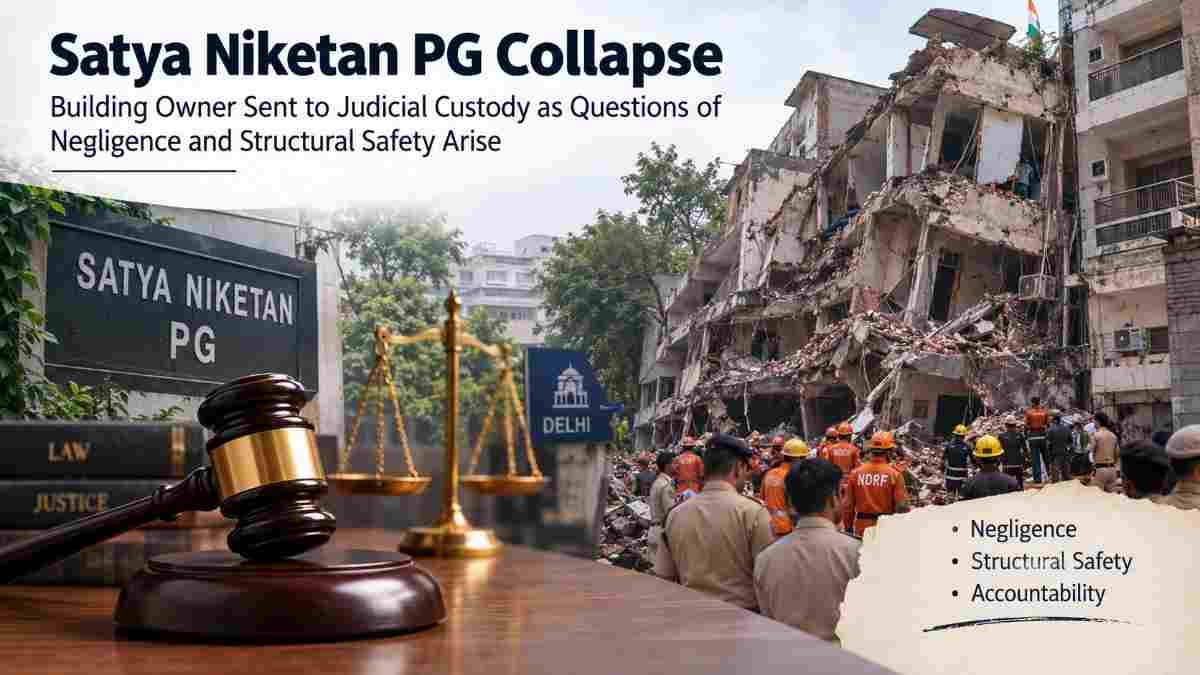
A Delhi court has sent building owner Hariram Gupta and his wife to 14 days of judicial custody, while their son has been remanded to two days of police custody in the Satya Niketan PG collapse case.
Why in News
The incident is currently in the news after a five-storey PG accommodation near Delhi University's South Campus collapsed on September 6, 2026, resulting in the deaths of seven people, including students and workers, and injuries to others.
The Delhi Police has arrested the alleged owner Hariram Gupta, his wife Urmila Gupta, and their son Mahesh Gupta. According to the material shown in the provided images, the owner and his wife were sent to judicial custody, while their son was sent to police custody for two days.
The Delhi High Court has also directed authorities to conduct a high-level inquiry into building permissions and a safety audit of PGs and hostels, bringing the issue beyond individual criminal liability to questions of regulatory responsibility.
Legal Issue
The major legal questions are:
- Whether the persons responsible for the building can be held criminally liable for the deaths caused by the collapse.
- Whether alleged unsafe construction, additional floors or negligent repair work contributed to the collapse.
- Whether failure to properly maintain a building can amount to a criminal offence.
- Whether the conduct satisfies the ingredients of culpable homicide not amounting to murder.
- Whether public authorities also failed in their statutory duty to inspect, regulate or prevent unsafe construction.
The reported FIR invokes Section 105 of the Bharatiya Nyaya Sanhita, 2023 (BNS) concerning culpable homicide not amounting to murder, along with provisions dealing with negligent conduct relating to buildings and acts endangering life or personal safety.
Important: Arrest or judicial custody does not mean that the accused have been found guilty. Criminal guilt must ultimately be established through evidence and trial.
Background
On September 6, 2026, a tragedy unfolded in Satya Niketan, Delhi, an area known for accommodation used by students, particularly those studying at Delhi University.
A multi-storey building being used as a boys' paying guest accommodation suddenly collapsed at around 1:30 PM while repair work was reportedly being carried out in the basement. The images provided with this post also highlight allegations that the basement was waterlogged and that such conditions may have weakened the structure.
The collapse trapped people under the debris. Seven people ultimately lost their lives, while others were injured. The incident immediately raised questions about whether the building was structurally safe and whether construction or repair activities had been carried out in accordance with applicable requirements.
Police subsequently arrested the alleged owner, Hariram Gupta, along with his wife Urmila and son Mahesh. Police investigations have examined the family's connection with the property and the management of the PG.
The case has also focused on the condition of the building. Reports indicate that investigators are examining alleged additional construction, the condition of the basement, waterlogging and repair work as possible contributing factors. These matters remain subject to investigation and must ultimately be established through evidence.
The Delhi Police registered a criminal case involving allegations of culpable homicide, negligent conduct relating to the building and endangering the safety of others.
The arrested persons were produced before the court. Hariram Gupta and Urmila Gupta were sent to judicial custody for 14 days, while Mahesh Gupta was sent to two days of police custody. The order was passed by Judicial Magistrate First Class Bhavya Kharail of the Patiala House Courts.
The matter has also reached the Delhi High Court. The Court has sought an inquiry into whether the collapsed building had valid construction permission and directed authorities to examine PG and hostel safety.
Thus, the case is not merely about one collapsed building. It raises a broader legal question: Who should be held responsible when unsafe construction, negligent maintenance or regulatory failure puts human lives at risk?
Landmark Cases
1. Jacob Mathew v. State of Punjab
(2005) 6 SCC 1 : AIR 2005 SC 3180
The Supreme Court explained the principles governing criminal negligence. It emphasized that criminal liability for negligence generally requires a sufficiently serious degree of negligence and not merely an ordinary error or lack of care.
Exam Point: Simple negligence and criminal negligence are not automatically the same.
2. Keshub Mahindra v. State of Madhya Pradesh
(1996) 6 SCC 129 : AIR 1996 SC 2239
The Supreme Court considered the distinction between culpable homicide and negligence in the context of the Bhopal gas tragedy proceedings.
Exam Point: For culpable homicide, the prosecution must establish the required mental element prescribed by criminal law; mere occurrence of death does not automatically establish culpable homicide.
3. Municipal Corporation of Delhi v. Association of Victims of Uphaar Tragedy
(2011) 14 SCC 481 : AIR 2012 SC 100
The Supreme Court dealt with questions concerning negligence, public authorities and compensation following the Uphaar cinema fire tragedy.
Exam Point: The case is important for understanding accountability for public safety and compensation where negligence results in loss of life.
4. M.C. Mehta v. Union of India
AIR 1987 SC 1086 : (1987) 1 SCC 395
The Supreme Court developed the principle of absolute liability for enterprises engaged in hazardous or inherently dangerous activities.
Exam Point: Though arising in a different factual context, the case is a major authority on protection of life and accountability for hazardous activities.
Importance
The Satya Niketan incident is important for every common citizen because people living in PGs, rented houses, hostels and multi-storey buildings depend upon basic structural safety.
The case also highlights that:
- Property ownership carries responsibilities.
- Unsafe construction can create criminal as well as civil consequences.
- Repair work must not compromise structural safety.
- Regulatory authorities may also face questions regarding inspection and enforcement.
- A private agreement cannot automatically remove statutory or criminal responsibility for unsafe conduct.
The incident has therefore triggered a wider discussion about structural audits and safety standards for PGs and hostels in Delhi.
Exam Snapshot — Judiciary/UPSC
Topic: Criminal liability arising from building collapse
Key provisions:
Section 105, BNS — Culpable homicide not amounting to murder
Section 290, BNS — Negligent conduct with respect to pulling down, repairing or constructing buildings
Section 125, BNS — Act endangering life or personal safety of others
Remember:
1. Death caused by negligence does not automatically mean culpable homicide.
2. Criminal negligence requires a legally sufficient degree of negligence.
3. Arrest ≠ conviction.
4. Judicial custody ≠ finding of guilt.
5. Building safety can involve both private responsibility and regulatory responsibility.
6. Jacob Mathew v. State of Punjab is a must-remember case for criminal negligence.
सत्या निकेतन PG हादसा: बिल्डिंग मालिक न्यायिक हिरासत में, लापरवाही और भवन सुरक्षा पर उठे गंभीर सवाल
सत्या निकेतन PG भवन गिरने के मामले में दिल्ली की अदालत ने हरिराम गुप्ता और उनकी पत्नी को 14 दिन की न्यायिक हिरासत, जबकि उनके बेटे को 2 दिन की पुलिस हिरासत में भेजा है।
खबरों में क्यों?
दिल्ली के सत्या निकेतन इलाके में दिल्ली विश्वविद्यालय के साउथ कैंपस के पास स्थित एक पांच मंजिला PG भवन 6 सितंबर 2026 को गिर गया। हादसे में सात लोगों की मौत हुई और कई लोग घायल हुए।
पुलिस ने भवन से जुड़े हरिराम गुप्ता, उनकी पत्नी उर्मिला गुप्ता और बेटे महेश गुप्ता को गिरफ्तार किया। उपलब्ध तस्वीरों में भी बताया गया है कि मालिक और उनकी पत्नी को न्यायिक हिरासत तथा बेटे को दो दिन की पुलिस हिरासत में भेजा गया।
दिल्ली हाई कोर्ट ने भी मामले को गंभीरता से लेते हुए भवन की अनुमति और सुरक्षा व्यवस्था की जांच तथा PG और हॉस्टल के सुरक्षा ऑडिट पर जोर दिया है।
कानूनी मुद्दा
इस मामले में मुख्य कानूनी सवाल हैं:
- भवन गिरने से हुई मौतों के लिए जिम्मेदार व्यक्तियों की आपराधिक जिम्मेदारी क्या होगी?
- क्या भवन में अतिरिक्त निर्माण या मरम्मत के कारण उसकी संरचना कमजोर हुई?
- क्या भवन की उचित देखभाल न करना आपराधिक अपराध बन सकता है?
- क्या आरोपित लोगों का आचरण आपराधिक मानव वध की श्रेणी में आता है?
- क्या सरकारी या स्थानीय अधिकारियों ने भवन की जांच और सुरक्षा सुनिश्चित करने में लापरवाही की?
पुलिस द्वारा दर्ज मामले में भारतीय न्याय संहिता, 2023 की धारा 105, भवन को गिराने, मरम्मत या निर्माण से संबंधित लापरवाही वाली धारा 290, और जीवन या व्यक्तिगत सुरक्षा को खतरे में डालने वाले कार्य से संबंधित धारा 125 का उल्लेख किया गया है।
ध्यान रखें: किसी व्यक्ति की गिरफ्तारी या न्यायिक हिरासत का अर्थ यह नहीं है कि वह दोषी साबित हो चुका है। दोष सिद्धि के लिए अदालत में सबूतों के आधार पर मुकदमा चलना आवश्यक है।
पूरी कहानी
6 सितंबर 2026 को दिल्ली के सत्या निकेतन इलाके में एक ऐसी घटना हुई जिसने छात्रों और PG में रहने वाले लोगों की सुरक्षा पर गंभीर सवाल खड़े कर दिए।
सत्या निकेतन दिल्ली विश्वविद्यालय के साउथ कैंपस के पास स्थित है और यहां बड़ी संख्या में छात्र PG में रहते हैं।
लगभग दोपहर 1:30 बजे एक पांच मंजिला PG भवन अचानक गिर गया। उस समय भवन के बेसमेंट में मरम्मत का काम चल रहा था। उपलब्ध तस्वीरों में यह भी बताया गया है कि बेसमेंट में पानी जमा था और स्थानीय लोगों के अनुसार इससे भवन की संरचना कमजोर हो सकती थी।
हादसे के बाद कई लोग मलबे में फंस गए। इस दुर्घटना में सात लोगों की जान चली गई, जबकि कई अन्य घायल हुए।
हादसे के बाद पुलिस ने भवन से जुड़े लोगों की भूमिका की जांच शुरू की। पुलिस ने कथित मालिक हरिराम गुप्ता, उनकी पत्नी उर्मिला गुप्ता और उनके बेटे महेश गुप्ता को गिरफ्तार किया। जांच में भवन के स्वामित्व और PG के संचालन से जुड़े पहलुओं को भी देखा जा रहा है।
जांच का एक महत्वपूर्ण हिस्सा भवन की स्थिति और उसमें किए गए काम हैं। रिपोर्टों के अनुसार, पुलिस अतिरिक्त निर्माण, बेसमेंट में पानी भरने और मरम्मत कार्य जैसे पहलुओं की जांच कर रही है। इन कारणों की अंतिम पुष्टि जांच और सबूतों के आधार पर ही होगी।
पुलिस ने मामले में आपराधिक मानव वध, भवन की मरम्मत या देखभाल में लापरवाही और दूसरों की जान को खतरे में डालने जैसे आरोप लगाए हैं।
गिरफ्तारी के बाद तीनों आरोपियों को अदालत के सामने पेश किया गया। हरिराम गुप्ता और उर्मिला गुप्ता को 14 दिन की न्यायिक हिरासत में भेजा गया, जबकि महेश गुप्ता को दो दिन की पुलिस हिरासत दी गई। यह आदेश पटियाला हाउस कोर्ट की न्यायिक मजिस्ट्रेट प्रथम श्रेणी भव्या खरैल ने पारित किया।
मामला दिल्ली हाई कोर्ट तक भी पहुंचा। हाई कोर्ट ने यह जांचने के निर्देश दिए कि भवन का निर्माण वैध अनुमति के तहत हुआ था या नहीं। साथ ही PG और हॉस्टल की सुरक्षा व्यवस्था की जांच पर भी जोर दिया गया।
इसलिए यह मामला केवल एक भवन गिरने की घटना नहीं है। यह एक बड़ा कानूनी सवाल उठाता है:
यदि किसी भवन की असुरक्षित स्थिति, लापरवाही से की गई मरम्मत या सरकारी निगरानी की कमी के कारण लोगों की जान खतरे में पड़ती है, तो जिम्मेदारी किसकी होगी?
लैंडमार्क केस
1. Jacob Mathew v. State of Punjab
(2005) 6 SCC 1 : AIR 2005 SC 3180
सुप्रीम कोर्ट ने आपराधिक लापरवाही के सिद्धांतों को स्पष्ट किया। हर सामान्य गलती या साधारण लापरवाही को आपराधिक लापरवाही नहीं माना जा सकता।
परीक्षा बिंदु: साधारण लापरवाही और आपराधिक लापरवाही में अंतर समझना जरूरी है।
2. Keshub Mahindra v. State of Madhya Pradesh
(1996) 6 SCC 129 : AIR 1996 SC 2239
इस मामले में सुप्रीम कोर्ट ने आपराधिक मानव वध और लापरवाही के बीच अंतर पर विचार किया।
परीक्षा बिंदु: केवल किसी व्यक्ति की मृत्यु हो जाने से अपने-आप आपराधिक मानव वध सिद्ध नहीं हो जाता। आवश्यक मानसिक तत्व और अन्य कानूनी तत्वों को साबित करना होता है।
3. Municipal Corporation of Delhi v. Association of Victims of Uphaar Tragedy
(2011) 14 SCC 481 : AIR 2012 SC 100
यह मामला सार्वजनिक सुरक्षा, लापरवाही और ऐसी घटना में मुआवजे से संबंधित महत्वपूर्ण सिद्धांतों के लिए जाना जाता है।
परीक्षा बिंदु: सार्वजनिक सुरक्षा में लापरवाही और पीड़ितों के मुआवजे की जिम्मेदारी से जुड़े प्रश्नों के लिए महत्वपूर्ण।
4. M.C. Mehta v. Union of India
AIR 1987 SC 1086 : (1987) 1 SCC 395
सुप्रीम कोर्ट ने खतरनाक गतिविधियों में लगे उद्योगों के लिए Absolute Liability का महत्वपूर्ण सिद्धांत विकसित किया।
परीक्षा बिंदु: यह मामला जीवन और सुरक्षा की रक्षा तथा खतरनाक गतिविधियों के लिए जिम्मेदारी के सिद्धांत को समझने के लिए महत्वपूर्ण है।
महत्व
यह घटना आम नागरिक के लिए बहुत महत्वपूर्ण है क्योंकि आज बड़ी संख्या में लोग PG, किराये के मकान और हॉस्टल में रहते हैं।
इस मामले से हमें समझ आता है कि:
- भवन मालिक की जिम्मेदारी होती है।
- असुरक्षित निर्माण के कानूनी परिणाम हो सकते हैं।
- मरम्मत का काम भवन की सुरक्षा को ध्यान में रखकर होना चाहिए।
- सरकारी अधिकारियों की निरीक्षण और निगरानी की जिम्मेदारी भी महत्वपूर्ण हो सकती है।
- केवल किसी समझौते में जिम्मेदारी से बचने वाली शर्त लिख देने से हर कानूनी जिम्मेदारी समाप्त नहीं हो जाती।
हादसे के बाद दिल्ली में PG और हॉस्टल की संरचनात्मक सुरक्षा जांच और ऑडिट की मांग तथा सरकारी कार्रवाई भी तेज हुई है।
परीक्षा के लिए मुख्य बिंदु — Judiciary/UPSC
- विषय: भवन गिरने से उत्पन्न आपराधिक जिम्मेदारी
- मुख्य धाराएं: धारा 105, BNS — आपराधिक मानव वध, हत्या नहीं धारा 290, BNS — भवन को गिराने, मरम्मत करने या निर्माण करने से संबंधित लापरवाही. धारा 125, BNS — जीवन या व्यक्तिगत सुरक्षा को खतरे में डालने वाला कार्य
याद रखने योग्य बातें:
1. लापरवाही से हुई मृत्यु का अर्थ अपने-आप आपराधिक मानव वध नहीं है।
2. आपराधिक लापरवाही के लिए कानून में आवश्यक स्तर की गंभीर लापरवाही साबित करनी होती है।
3. गिरफ्तारी का अर्थ दोष सिद्ध होना नहीं है।
4. न्यायिक हिरासत का अर्थ दोषी होना नहीं है।
5. भवन की सुरक्षा में मालिक के साथ-साथ नियामक अधिकारियों की भूमिका भी महत्वपूर्ण हो सकती है।
6. Jacob Mathew v. State of Punjab — आपराधिक लापरवाही का प्रमुख केस।