Public Examinations Amendment Bill 2026: Stricter Punishment and Fast-Track Justice for Exam Malpractices
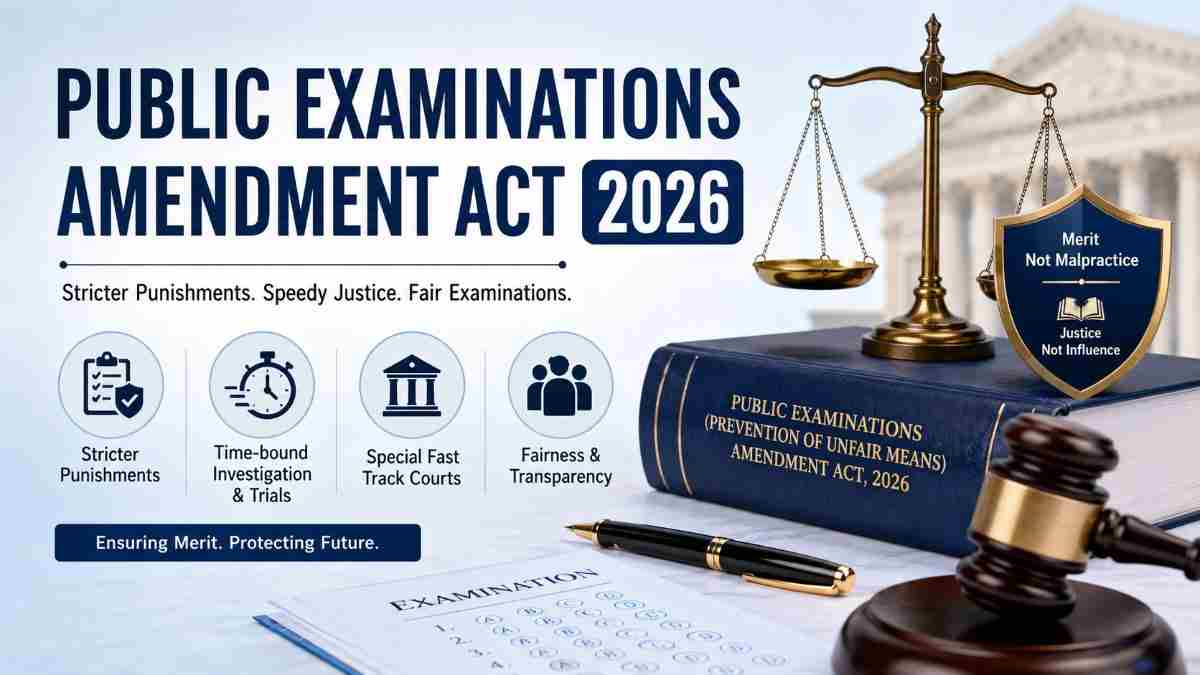
The Public Examinations (Prevention of Unfair Means) Amendment Bill, 2026 strengthens the 2024 law by increasing punishments, introducing time-bound investigation and trials, Special Task Forces, and Special Fast Track Courts.
Important Update:
Although widely called the “2026 Amendment Bill”, Parliament passed it on 30 July 2026 and the President gave assent on 31 July 2026; it is now the Public Examinations (Prevention of Unfair Means) Amendment Act, 2026 (Act No. 10 of 2026).
Why in News
The amendment is in the news because Parliament has strengthened the legal framework against question-paper leaks, cheating and organised examination malpractice.
The Bill was introduced in the Lok Sabha on 27 July 2026 and passed by both Houses by voice vote on 29 and 30 July respectively. The President gave assent on 31 July 2026.
The government stated that recent incidents of question-paper leaks and examination malpractices had affected the transparency, fairness and credibility of public examinations. The amendment therefore focuses not only on stricter punishment, but also on speedier investigation and trial.
Legal Issue
The main legal issue is:
How can the law effectively prevent unfair means in public examinations while ensuring strict punishment, speedy investigation and a fair judicial process?
The amendment modifies the Public Examinations (Prevention of Unfair Means) Act, 2024, which applies to specified public examinations conducted by authorities such as UPSC, SSC, Railway Recruitment Boards, IBPS and NTA, among others.
Background
Imagine thousands of students preparing for a competitive examination. They spend months studying, hoping that their performance will decide their future. But when a question paper is leaked or organised cheating takes place, the entire examination system is affected—not just one student.
India already had the Public Examinations (Prevention of Unfair Means) Act, 2024, which created a central legal framework to deal with unfair means in specified public examinations.
However, continuing concerns over examination malpractices led Parliament to strengthen this framework in 2026.
The biggest change is the increase in punishment. For an individual using unfair means, imprisonment has increased from 3–5 years to 5–10 years, while the maximum fine has increased from ₹10 lakh to ₹50 lakh.
For service providers involved in malpractice, the maximum fine has been increased from ₹1 crore to ₹5 crore, and the period of debarment from conducting public examinations has increased from 4 years to 8 years.
For persons in charge of a service provider who are involved in an offence, the minimum imprisonment has been raised to 5 years, with a fine up to ₹5 crore. For organised examination-related crime, the minimum imprisonment has increased from 5 years to 7 years, while the minimum fine has increased from ₹1 crore to ₹10 crore.
But punishment is only one part of the reform.
The amendment also creates a system for time-bound investigation. Investigations are to be completed within two months. The Central Government may also constitute a Special Task Force for investigation.
Every State and Union Territory must designate a Court of Session as a Special Fast Track Court, in consultation with the concerned High Court Chief Justice. Trials are to proceed on a day-to-day basis and, subject to the statutory framework, be completed within three months from filing of the chargesheet. Special Public Prosecutors are also to be appointed.
The amendment further provides an appeal to a bench of two High Court Judges. Ordinarily, an appeal must be filed within 30 days, with limited scope for condonation up to 90 days, and appeals are intended to be disposed of within three months of admission.
Thus, the 2026 amendment attempts to address the entire chain—from investigation → prosecution → trial → appeal.
Landmark Cases
1. Maharashtra State Board of Secondary and Higher Secondary Education v. Paritosh Bhupeshkumar Sheth
Citation: Maharashtra State Board of Secondary and Higher Secondary Education v. Paritosh Bhupeshkumar Sheth, (1984) 4 SCC 27 : AIR 1984 SC 1543.
Principle: The Supreme Court recognised the importance of finality in public examinations and held that courts should not ordinarily direct re-evaluation where the governing rules do not provide for it.
2. Kanpur University v. Samir Gupta
Citation: Kanpur University v. Samir Gupta, (1983) 4 SCC 309 : AIR 1983 SC 1230 : (1984) 1 SCR 73.
Principle: Where an examination answer key is demonstrably wrong, courts may intervene to protect fairness. The case highlights the importance of correctness and fairness in examination processes.
3. Ran Vijay Singh v. State of U.P.
Citation: Ran Vijay Singh v. State of U.P., (2018) 2 SCC 357 : AIR 2018 SC 52 : (2017) 12 SCR 95.
Principle: Courts should exercise great restraint in interfering with examination results. Judicial intervention is generally limited to rare and exceptional cases where a clear material error is demonstrated.
Importance
For the common citizen and students, the amendment is important because a fair examination system is directly connected with equal opportunity.
It aims to:
- Protect genuine candidates from organised cheating.
- Make paper leaks and examination fraud more costly.
- Ensure investigations do not remain pending indefinitely.
- Provide dedicated courts for speedy disposal.
- Make examination service providers more accountable.
- Strengthen confidence in government recruitment and entrance examinations.
At the same time, implementation will be important. Strict statutory timelines must operate consistently with principles of fair trial, natural justice and judicial independence.
Exam Snapshot: Judiciary/UPSC
2026 Amendment
- Parent law Public Examinations (Prevention of Unfair Means) Act, 2024
- Amendment Act Act No. 10 of 2026
- President's assent 31 July 2026
- Individual offender 5–10 years + fine up to ₹50 lakh
- Service provider Fine up to ₹5 crore
- Service-provider debarment 8 years
- Persons in charge Minimum 5 years + fine up to ₹5 crore
- Organised crime 7–10 years + minimum ₹10 crore fine
- Investigation Within 2 months
- Special Court Special Fast Track Court
- Trial Within 3 months from chargesheet
- Appeal Two-Judge High Court Bench
- Appeal filing 30 days; limited extension up to 90 days
Memory Trick:
“5–50 | 5–5 | 7–10 | 2–3”
5–50: Individual → 5–10 years + ₹50 lakh maximum fine
5–5: Service-provider responsible persons → minimum 5 years + ₹5 crore fine
7–10: Organised crime → minimum 7 years + ₹10 crore minimum fine
2–3: Investigation → 2 months; Trial → 3 months
Public Examinations Amendment Act 2026: परीक्षा में नकल और पेपर लीक पर सख्ती, तेज होगी कानूनी कार्रवाई
2026 के संशोधन ने सार्वजनिक परीक्षाओं में नकल और अनुचित साधनों के लिए सजा बढ़ाई है तथा जांच और सुनवाई को समयबद्ध बनाने के लिए विशेष व्यवस्था की है।
महत्वपूर्ण अपडेट: इसे आम तौर पर “2026 Amendment Bill” कहा जा रहा है, लेकिन संसद से पारित होने के बाद राष्ट्रपति ने 31 जुलाई 2026 को मंजूरी दे दी। अब यह Public Examinations (Prevention of Unfair Means) Amendment Act, 2026 — Act No. 10 of 2026 है।
खबरों में क्यों?
यह कानून इसलिए चर्चा में है क्योंकि सार्वजनिक परीक्षाओं में पेपर लीक, नकल और संगठित परीक्षा धोखाधड़ी से निपटने के लिए कानून को और कड़ा किया गया है।
Bill को 27 जुलाई 2026 को लोकसभा में पेश किया गया और 29 जुलाई को लोकसभा तथा 30 जुलाई को राज्यसभा ने इसे पारित किया। इसके बाद 31 जुलाई 2026 को राष्ट्रपति की मंजूरी मिली।
सरकार के अनुसार, हाल के पेपर लीक और परीक्षा में गड़बड़ी के मामलों ने सार्वजनिक परीक्षाओं की निष्पक्षता और विश्वसनीयता को प्रभावित किया। इसलिए संशोधन में केवल सजा बढ़ाने के बजाय जांच और मुकदमे को भी तेज करने पर जोर दिया गया है।
कानूनी मुद्दा
मुख्य कानूनी सवाल यह है:
सार्वजनिक परीक्षाओं में नकल और धोखाधड़ी को कैसे रोका जाए तथा दोषियों को कड़ी सजा देते हुए जांच और मुकदमे को भी निष्पक्ष एवं तेज कैसे बनाया जाए?
यह संशोधन Public Examinations (Prevention of Unfair Means) Act, 2024 में बदलाव करता है। यह कानून UPSC, SSC, Railway Recruitment Boards, IBPS और NTA जैसी निर्धारित सार्वजनिक परीक्षा संस्थाओं की परीक्षाओं पर लागू होता है।
पूरी कहानी
कल्पना कीजिए कि हजारों विद्यार्थी किसी प्रतियोगी परीक्षा की तैयारी करते हैं। वे महीनों मेहनत करते हैं और अपनी योग्यता के आधार पर सफलता की उम्मीद रखते हैं। लेकिन अगर परीक्षा से पहले पेपर लीक हो जाए या कोई संगठित तरीके से नकल करवाए, तो केवल एक विद्यार्थी का नुकसान नहीं होता, बल्कि पूरी परीक्षा व्यवस्था की विश्वसनीयता प्रभावित होती है।
इसी समस्या से निपटने के लिए भारत में Public Examinations (Prevention of Unfair Means) Act, 2024 बनाया गया था।
लेकिन परीक्षा संबंधी गड़बड़ियों की चिंता को देखते हुए 2026 में इस कानून को और मजबूत किया गया।
सबसे बड़ा बदलाव सजा में वृद्धि है। अनुचित साधनों का इस्तेमाल करने वाले व्यक्ति के लिए पहले 3 से 5 वर्ष तक की जेल और ₹10 लाख तक जुर्माना था। अब जेल की सजा 5 से 10 वर्ष और जुर्माना ₹50 लाख तक हो सकता है।
परीक्षा से जुड़ा कोई service provider अगर गड़बड़ी में शामिल होता है, तो अधिकतम जुर्माना ₹5 करोड़ किया गया है। उसे सार्वजनिक परीक्षा आयोजित करने से 8 वर्ष तक रोका जा सकता है।
Service provider के जिम्मेदार व्यक्ति के लिए न्यूनतम जेल की सजा 5 वर्ष और जुर्माना ₹5 करोड़ तक हो सकता है।
संगठित परीक्षा अपराध के मामले में न्यूनतम जेल की सजा 7 वर्ष और न्यूनतम जुर्माना ₹10 करोड़ कर दिया गया है।
लेकिन कानून केवल सजा तक सीमित नहीं है।
जांच को 2 महीने के भीतर पूरा करने का प्रावधान किया गया है। केंद्र सरकार जरूरत पड़ने पर Special Task Force भी बना सकती है।
हर राज्य और केंद्रशासित प्रदेश को संबंधित हाई कोर्ट के मुख्य न्यायाधीश से परामर्श करके Special Fast Track Court के रूप में Court of Session को नामित करना होगा।
इन मामलों की सुनवाई दिन-प्रतिदिन करने का प्रावधान है और chargesheet दाखिल होने के बाद मुकदमा सामान्यतः 3 महीने के भीतर पूरा किया जाना है। विशेष सरकारी वकील यानी Special Public Prosecutor की नियुक्ति भी की जाएगी।
इसके अलावा Special Fast Track Court के फैसले के खिलाफ हाई कोर्ट में दो न्यायाधीशों की Bench के सामने अपील का प्रावधान है।
इस प्रकार 2026 का संशोधन पूरी प्रक्रिया को मजबूत करता है:
जांच → अभियोजन → ट्रायल → अपील
और उद्देश्य है कि परीक्षा में धोखाधड़ी करने वालों के खिलाफ कार्रवाई केवल कड़ी ही नहीं, बल्कि तेज और प्रभावी भी हो।
लैंडमार्क केस
1. Maharashtra State Board of Secondary and Higher Secondary Education v. Paritosh Bhupeshkumar Sheth
Citation: Maharashtra State Board of Secondary and Higher Secondary Education v. Paritosh Bhupeshkumar Sheth, (1984) 4 SCC 27 : AIR 1984 SC 1543.
सिद्धांत: सुप्रीम कोर्ट ने सार्वजनिक परीक्षाओं में अंतिमता और परीक्षा नियमों के महत्व को माना। जहां नियमों में re-evaluation का अधिकार नहीं है, वहां अदालत सामान्यतः re-evaluation का आदेश नहीं देगी।
2. Kanpur University v. Samir Gupta
Citation: Kanpur University v. Samir Gupta, (1983) 4 SCC 309 : AIR 1983 SC 1230 : (1984) 1 SCR 73.
सिद्धांत: यदि answer key स्पष्ट रूप से गलत हो, तो निष्पक्षता बनाए रखने के लिए अदालत हस्तक्षेप कर सकती है। यह मामला परीक्षा प्रक्रिया में सही answer key और fairness के महत्व को बताता है।
3. Ran Vijay Singh v. State of U.P.
Citation: Ran Vijay Singh v. State of U.P., (2018) 2 SCC 357 : AIR 2018 SC 52 : (2017) 12 SCR 95.
सिद्धांत: परीक्षा के परिणामों में अदालतों को बहुत सावधानी से हस्तक्षेप करना चाहिए। केवल दुर्लभ और असाधारण परिस्थितियों में, जब स्पष्ट और महत्वपूर्ण गलती दिखाई दे, तब न्यायिक हस्तक्षेप उचित हो सकता है।
महत्व
आम नागरिक और विद्यार्थियों के लिए यह कानून इसलिए महत्वपूर्ण है क्योंकि सरकारी भर्ती और प्रवेश परीक्षाओं में समान अवसर बहुत जरूरी है।
इसके प्रमुख लाभ हैं:
- मेहनत करने वाले विद्यार्थियों के अधिकारों की रक्षा।
- पेपर लीक और संगठित नकल पर सख्त कार्रवाई।
- जांच में अनावश्यक देरी को कम करना।
- मामलों की तेज सुनवाई के लिए विशेष अदालतें।
- परीक्षा कराने वाली संस्थाओं और service providers की जवाबदेही बढ़ाना।
- सार्वजनिक परीक्षाओं पर लोगों का विश्वास मजबूत करना।
हालांकि, कानून को लागू करते समय निष्पक्ष सुनवाई, प्राकृतिक न्याय और न्यायिक स्वतंत्रता जैसे सिद्धांतों का भी ध्यान रखना आवश्यक होगा।
परीक्षा के लिए मुख्य बिंदु
2026 संशोधन
- मूल कानून Public Examinations (Prevention of Unfair Means) Act, 2024
- संशोधन कानून Act No. 10 of 2026
- राष्ट्रपति की मंजूरी 31 जुलाई 2026
- व्यक्तिगत अपराध 5–10 वर्ष + ₹50 लाख तक जुर्माना
- Service Provider ₹5 करोड़ तक जुर्माना
- Debarment 8 वर्ष
- जिम्मेदार व्यक्ति न्यूनतम 5 वर्ष + ₹5 करोड़ तक जुर्माना
- Organised Crime न्यूनतम 7 वर्ष + न्यूनतम ₹10 करोड़ जुर्माना
- जांच 2 महीने
- विशेष अदालत Special Fast Track Court
- ट्रायल Chargesheet के 3 महीने के भीतर
- अपील हाई कोर्ट की दो-जज Bench
- अपील की अवधि 30 दिन; सीमित स्थिति में 90 दिन तक
Exam Memory Trick
“5–50 | 5–5 | 7–10 | 2–3”
5–50: व्यक्ति → 5–10 वर्ष + ₹50 लाख तक
5–5: जिम्मेदार व्यक्ति → न्यूनतम 5 वर्ष + ₹5 करोड़ तक
7–10: संगठित अपराध → न्यूनतम 7 वर्ष + न्यूनतम ₹10 करोड़
2–3: जांच → 2 महीने; ट्रायल → 3 महीने