Guardian of Minor’s Property: Supreme Court Clarifies the “Best Interest of the Child” Test under Section 8 HMGA
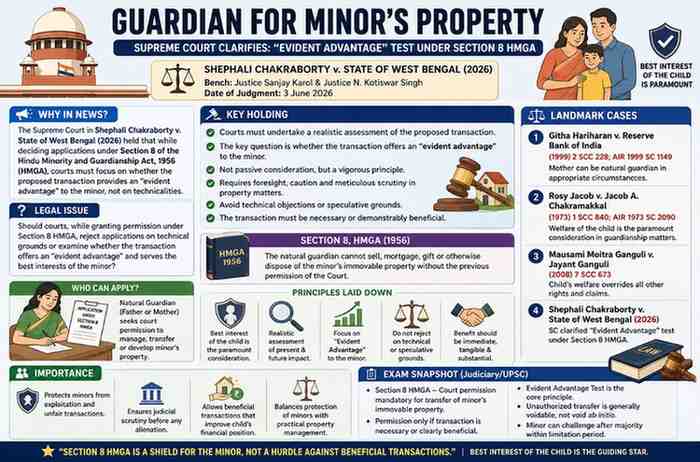
The Supreme Court has held that while deciding applications under Section 8 of the Hindu Minority and Guardianship Act, 1956, courts must focus on whether the transaction provides an “evident advantage” to the minor rather than rejecting it on technical grounds.
The issue is currently in discussion because the Supreme Court, in Shephali Chakraborty v. State of West Bengal (2026), clarified how courts should deal with applications filed by natural guardians seeking permission to manage, transfer, or develop a minor’s property under Section 8 of the Hindu Minority and Guardianship Act, 1956 (HMGA).
The judgment was delivered by a Bench comprising Justice Sanjay Karol and Justice Nongmeikapam Kotiswar Singh on 3 June 2026. The Court emphasized that the primary consideration should always be the welfare and tangible benefit of the minor.
Legal Issue
Whether courts, while granting permission under Section 8 HMGA, should strictly follow technical objections or examine whether the proposed transaction provides an “evident advantage” and serves the best interests of the minor
The case arose from a family property dispute involving a minor child. The minor had an undivided share in a property after the death of the father. Other co-owners proposed entering into a development agreement so that the property could be commercially developed and the stakeholders could receive completed residential units and monetary benefits.
Since the minor’s share was involved, the child’s mother, acting as the natural guardian, approached the court under Section 8 of the Hindu Minority and Guardianship Act, 1956 seeking permission for the transaction.
The lower courts were hesitant because property belonging to a minor enjoys special legal protection. The concern was whether entering into a development agreement might adversely affect the minor’s future rights.
When the matter reached the Supreme Court, the Court examined the purpose of Section 8. The Court observed that the provision is not intended to create unnecessary hurdles. Instead, it exists to protect minors from unfair or harmful transactions.
The Supreme Court stated that courts must undertake a realistic assessment of the proposed transaction. The key question is whether the arrangement offers an “evident advantage” to the minor. Courts should not reject applications merely because of speculative concerns or technical objections.
The Bench reiterated that the best interest of the child is not a symbolic principle but a substantive legal standard. Judges must carefully examine present and future consequences and determine whether the transaction is necessary or demonstrably beneficial for the minor.
In this case, the Court found that an undeveloped and undivided share in property had limited practical utility. Under the development arrangement, the minor would receive a completed residential unit and liquid financial benefits. Such benefits were immediate, tangible, and clearly advantageous.
Accordingly, the Supreme Court allowed the appeal and granted approval for the mother to proceed with the development agreement on behalf of the minor.
Landmark Cases
1. Githa Hariharan v. Reserve Bank of India (1999) 2 SCC 228; AIR 1999 SC 1149
The Supreme Court interpreted Section 6 HMGA and held that the mother can also act as a natural guardian during circumstances where the father is absent or unable to discharge his duties. The judgment promoted gender equality in guardianship law.
2. Rosy Jacob v. Jacob A. Chakramakkal (1973) 1 SCC 840; AIR 1973 SC 2090
The Court held that the welfare of the child is the paramount consideration in all guardianship matters.
3. Mausami Moitra Ganguli v. Jayant Ganguli (2008) 7 SCC 673
The Supreme Court reiterated that the child’s welfare overrides all other legal rights and claims.
4. Shephali Chakraborty v. State of West Bengal
The Court clarified the application of Section 8 HMGA and emphasized the concept of “evident advantage” while dealing with a minor’s property.
Importance
- For Citizens
- Protects minors from exploitation.
- Ensures judicial scrutiny before alienation of a minor’s property.
- Allows beneficial transactions that genuinely improve a child’s financial position.
- Balances protection of minors with practical property management.
For Lawyers and Judges
- Shifts focus from technicalities to substantive welfare.
- Introduces a practical “evident advantage” test.
- Strengthens the doctrine of the best interest of the child.
Exam Snapshot (Judiciary/UPSC)
Section 8, HMGA, 1956
Natural guardian cannot transfer, sell, mortgage, gift, or otherwise dispose of a minor’s immovable property without court permission.
Court permission is granted only when the transaction is necessary or clearly beneficial to the minor.
Key Principles from Shephali Chakraborty Case
- “Best Interest of the Child” is the governing principle.
- Courts must conduct a realistic assessment.
- Focus on “Evident Advantage” to the minor.
- Avoid rejection based on speculative concerns.
- Unauthorized transfer is generally voidable, not void ab initio.
- Minor may challenge such transfer after attaining majority within the prescribed limitation period.
One-Line Exam Quote:
"Section 8 HMGA is a shield for the minor, not a hurdle against beneficial transactions."
---
नाबालिग की संपत्ति का संरक्षक: सुप्रीम कोर्ट ने Section 8 HMGA में “बालक के सर्वोत्तम हित” की कसौटी स्पष्ट की
सुप्रीम कोर्ट ने कहा है कि Section 8 HMGA के तहत नाबालिग की संपत्ति से जुड़े मामलों में अदालतों को तकनीकी आपत्तियों के बजाय यह देखना चाहिए कि प्रस्तावित लेन-देन से नाबालिग को स्पष्ट और वास्तविक लाभ मिल रहा है या नहीं।
हाल ही में सुप्रीम कोर्ट ने Shephali Chakraborty v. State of West Bengal (2026) मामले में महत्वपूर्ण फैसला दिया। न्यायालय ने स्पष्ट किया कि हिंदू अल्पसंख्यकता एवं संरक्षकता अधिनियम, 1956 (HMGA) की धारा 8 के तहत नाबालिग की संपत्ति के प्रबंधन या हस्तांतरण के लिए अनुमति देते समय अदालतों को सबसे पहले नाबालिग के हित और लाभ को देखना चाहिए।
यह निर्णय न्यायमूर्ति संजय करोल और न्यायमूर्ति एन. कोटिश्वर सिंह की पीठ ने 3 जून 2026 को दिया।
कानूनी मुद्दा
क्या धारा 8 HMGA के अंतर्गत अदालतें केवल तकनीकी आधारों पर अनुमति से इनकार कर सकती हैं, या उन्हें यह जांचना चाहिए कि प्रस्तावित लेन-देन नाबालिग को “स्पष्ट लाभ (Evident Advantage)” देता है और उसके सर्वोत्तम हित (Best Interest of the Child) में है?
यह मामला एक ऐसे परिवार से जुड़ा था जिसमें पिता की मृत्यु के बाद एक नाबालिग बच्चे का संपत्ति में अविभाजित हिस्सा (Undivided Share) था। संपत्ति के अन्य सह-मालिक उस भूमि का विकास (Development) करना चाहते थे ताकि भविष्य में सभी हितधारकों को विकसित फ्लैट और आर्थिक लाभ प्राप्त हो सके।
चूंकि उस संपत्ति में नाबालिग का भी हिस्सा था, इसलिए उसकी मां ने प्राकृतिक संरक्षक (Natural Guardian) के रूप में धारा 8 HMGA के तहत अदालत से अनुमति मांगी। उनका कहना था कि विकास समझौते से बच्चे को भविष्य में अधिक लाभ मिलेगा।
निचली अदालतों के सामने यह चिंता थी कि नाबालिग की संपत्ति को विशेष कानूनी संरक्षण प्राप्त है। इसलिए यह देखा जाना आवश्यक था कि कहीं यह समझौता बच्चे के भविष्य के अधिकारों को प्रभावित तो नहीं करेगा।
मामला सुप्रीम कोर्ट पहुंचा। न्यायालय ने कहा कि धारा 8 का उद्देश्य नाबालिग की संपत्ति को सुरक्षित रखना है, न कि लाभकारी लेन-देन को अनावश्यक रूप से रोकना। अदालतों का कर्तव्य है कि वे वास्तविक परिस्थितियों का मूल्यांकन करें और यह देखें कि प्रस्तावित लेन-देन से नाबालिग को “स्पष्ट लाभ” मिल रहा है या नहीं।
सुप्रीम कोर्ट ने कहा कि “बालक का सर्वोत्तम हित” केवल एक औपचारिक सिद्धांत नहीं है, बल्कि यह एक प्रभावी कानूनी मानक है। न्यायालय को वर्तमान और भविष्य दोनों प्रभावों का सावधानीपूर्वक परीक्षण करना चाहिए।
इस मामले में अदालत ने पाया कि अविकसित और अविभाजित संपत्ति का हिस्सा व्यावहारिक रूप से सीमित उपयोग का था। दूसरी ओर, विकास समझौते के तहत नाबालिग को एक तैयार आवासीय इकाई तथा नकद आर्थिक लाभ मिलने वाला था। यह लाभ वास्तविक, तात्कालिक और स्पष्ट था। इसी आधार पर सुप्रीम कोर्ट ने अपील स्वीकार कर ली और मां को नाबालिग की ओर से विकास समझौते में प्रवेश करने की अनुमति प्रदान की।
लैंडमार्क केस
1. Githa Hariharan v. Reserve Bank of India (1999) 2 SCC 228; AIR 1999 SC 1149
सुप्रीम कोर्ट ने कहा कि उचित परिस्थितियों में मां भी प्राकृतिक संरक्षक के रूप में कार्य कर सकती है। यह निर्णय संरक्षकता कानून में लैंगिक समानता को बढ़ावा देता है।
2. Rosy Jacob v. Jacob A. Chakramakkal (1973) 1 SCC 840; AIR 1973 SC 2090
न्यायालय ने कहा कि संरक्षकता से जुड़े सभी मामलों में बच्चे का कल्याण सर्वोपरि होगा।
3. Mausami Moitra Ganguli v. Jayant Ganguli (2008) 7 SCC 673
सुप्रीम कोर्ट ने दोहराया कि बच्चे का हित माता-पिता के अधिकारों से भी ऊपर है।
4. Shephali Chakraborty v. State of West Bengal
इस निर्णय में सुप्रीम कोर्ट ने धारा 8 HMGA के अंतर्गत “Evident Advantage” की अवधारणा को स्पष्ट किया और नाबालिग के सर्वोत्तम हित को प्रमुख मानदंड बताया।
महत्व
- आम नागरिकों के लिए
- नाबालिगों की संपत्ति को कानूनी सुरक्षा मिलती है।
- माता-पिता या संरक्षक मनमाने ढंग से संपत्ति का हस्तांतरण नहीं कर सकते।
- यदि कोई लेन-देन बच्चे के हित में है तो अदालत अनुमति दे सकती है।
- संपत्ति प्रबंधन और बाल संरक्षण के बीच संतुलन स्थापित होता है।
विधि छात्रों और प्रैक्टिशनर्स के लिए
- धारा 8 HMGA की व्यावहारिक व्याव्याख्य
- “Evident Advantage Test” का महत्व।
- “Best Interest of the Child” सिद्धांत की पुनः पुष्टि।
- तकनीकीताओं की बजाय वास्तविक लाभ पर जोर।
परीक्षा के लिए मुख्य बिंदु (Judiciary/UPSC)
धारा 8, HMGA, 1956
प्राकृतिक संरक्षक बिना न्यायालय की अनुमति के नाबालिग की अचल संपत्ति को बेच, गिरवी, दान या हस्तांतरित नहीं कर सकता।
अनुमति तभी दी जाएगी जब लेन-देन आवश्यक हो या नाबालिग के स्पष्ट हित में हो।
Shephali Chakraborty केस के मुख्य सिद्धांत
- “Best Interest of the Child” सर्वोच्च मासिद्धांत
- अदालत को वास्तविक परिस्थितियों का मूल्यांकन करना होगा।
- “Evident Advantage” की जांच आवश्यक है।
- केवल तकनीकी आधारों पर आवेदन खारिज नहीं किया जाना चाहिए।
- बिना अनुमति किया गया हस्तांतरण सामान्यतः Voidable होता है, Void ab Initio नहीं।
- वयस्क होने के बाद नाबालिग सीमावधि के भीतर ऐसे हस्तांतरण को चुनौती दे सकता है।
“धारा 8 HMGA का उद्देश्य नाबालिग की सुरक्षा है, लाभकारी लेन-देन को रोकना नहीं।”