Compensation for Illegal Detention: Allahabad High Court Orders ₹10 Lakh for Violation of Personal Liberty
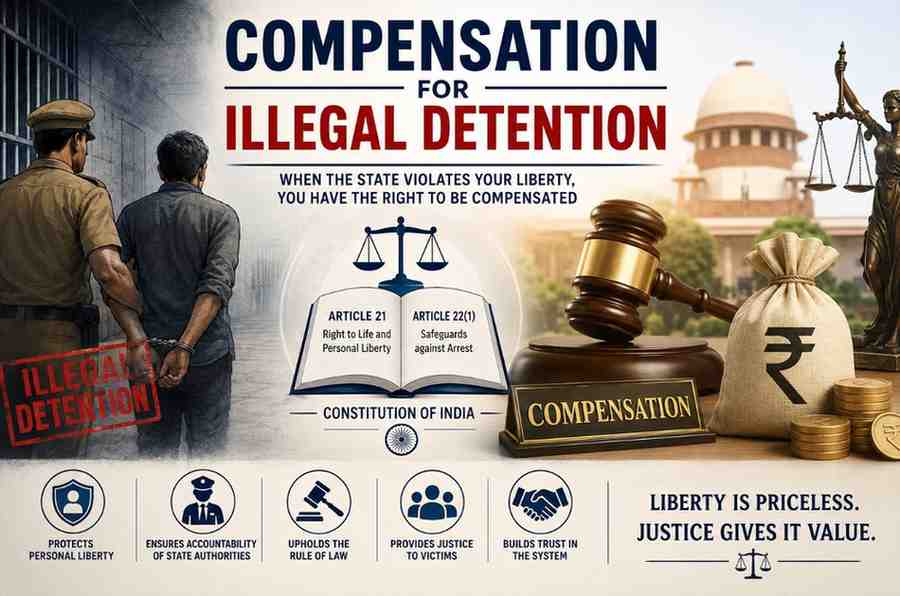 Allahabad High Court awarded ₹10 lakh compensation for illegal detention, reinforcing strict safeguards under Article 21 & 22.
The Allahabad High Court recently directed the Uttar Pradesh Government to pay ₹10 lakh compensation in a case of illegal arrest and detention for over 3 months. The judgment is significant because it strengthens the requirement of providing written grounds of arrest, following the latest Supreme Court ruling.
Legal Issue
Whether failure to provide written grounds of arrest makes detention illegal and entitles the victim to compensation?
In a recent case titled Manoj Kumar through his son Mudit Kumar v. State of U.P., a man was illegally arrested and kept in custody for more than three months. During this period, the authorities failed to provide him with written grounds of arrest—an essential legal safeguard.
The Allahabad High Court examined the facts carefully and found that the State had violated the petitioner’s personal liberty. The Court emphasized that informing a person about the reasons for arrest is not a mere formality—it is a fundamental right guaranteed under Article 22(1) of the Constitution.
The Court observed that without written grounds of arrest, the accused cannot effectively defend himself or seek legal remedies like bail. This failure directly curtails personal liberty under Article 21.
Importantly, the Court relied on a recent Supreme Court judgment in Mihir Rajesh Shah v. State of Maharashtra, 2025 LiveLaw (SC) 1066. The Apex Court held that if the grounds of arrest are not provided in writing, and in a language understood by the accused, the arrest itself becomes illegal, along with any subsequent detention.
Applying this principle, the High Court concluded that the detention of the petitioner was unlawful. As a result, it awarded ₹10 lakh compensation, holding the State accountable for violating fundamental rights.
This case shows a strong judicial stance: procedural safeguards are not optional—they are mandatory. Any violation will attract strict consequences, including monetary compensation.
Landmark Cases
1. Rudul Sah v. State of Bihar, AIR 1983 SC 1086
Established that compensation can be awarded under writ jurisdiction for illegal detention.
2. Bhim Singh v. State of J&K, (1985) 4 SCC 677
Compensation granted for wrongful arrest of a legislator.
3. Nilabati Behera v. State of Orissa, (1993) 2 SCC 746
Recognized compensation as a public law remedy for violation of Article 21.
4. D.K. Basu v. State of West Bengal, (1997) 1 SCC 416 Laid down arrest and detention guidelines to prevent abuse.
5. Mihir Rajesh Shah v. State of Maharashtra, 2025 LiveLaw (SC) 1066
Held that failure to provide written grounds of arrest makes arrest and remand illegal.
Importance
● Reinforces mandatory procedure in arrests
● Protects citizens from arbitrary police action
● Ensures transparency and fairness
● Strengthens Article 21 & 22 protections
● Holds State financially accountable
Exam Snapshot
● Written grounds of arrest = Mandatory
● Article 21 + 22(1) violation → Compensation
● Compensation = Public Law Remedy
● Latest case: *Mihir Rajesh Shah (2025)*
● High Court can award compensation under Article 226
● Illegal arrest = Illegal detention = Liability of State
---
अवैध हिरासत पर ₹10 लाख मुआवजा: इलाहाबाद हाई कोर्ट का सख्त संदेश
इलाहाबाद हाई कोर्ट ने अवैध गिरफ्तारी और हिरासत के लिए ₹10 लाख मुआवजा दिया।
हाल ही में इलाहाबाद हाई कोर्ट ने उत्तर प्रदेश सरकार को एक व्यक्ति को ₹10 लाख मुआवजा देने का आदेश दिया, जिसे 3 महीने से अधिक समय तक अवैध रूप से हिरासत में रखा गया था। यह फैसला इसलिए महत्वपूर्ण है क्योंकि इसमें लिखित रूप में गिरफ्तारी के कारण बताना अनिवार्य बताया गया।
कानूनी मुद्दा
क्या लिखित रूप में गिरफ्तारी के कारण न बताने पर गिरफ्तारी अवैध हो जाती है और मुआवजा दिया जा सकता है?
Manoj Kumar बनाम State of U.P.* मामले में एक व्यक्ति को पुलिस ने गिरफ्तार किया और 3 महीने से ज्यादा समय तक हिरासत में रखा। लेकिन इस दौरान उसे गिरफ्तारी के लिखित कारण नहीं बताए गए।
इलाहाबाद हाई कोर्ट ने इस मामले को गंभीरता से लिया और कहा कि यह केवल प्रक्रिया की गलती नहीं, बल्कि मौलिक अधिकारों का उल्लंघन है। Article 22(1) के तहत हर व्यक्ति को यह अधिकार है कि उसे गिरफ्तारी के कारण बताए जाएं।
कोर्ट ने कहा कि अगर लिखित कारण नहीं दिए जाते, तो व्यक्ति अपनी रक्षा नहीं कर सकता और जमानत या अन्य कानूनी उपाय नहीं ले सकता। यह सीधे तौर पर उसकी व्यक्तिगत स्वतंत्रता (Article 21) का उल्लंघन है।
कोर्ट ने सुप्रीम कोर्ट के हालिया फैसले *Mihir Rajesh Shah v. State of Maharashtra (2025)* पर भरोसा किया, जिसमें कहा गया कि अगर गिरफ्तारी के कारण लिखित रूप में और समझ आने वाली भाषा में नहीं दिए जाते, तो गिरफ्तारी और आगे की हिरासत दोनों अवैध हो जाती हैं।
इसी आधार पर हाई कोर्ट ने कहा कि यह हिरासत पूरी तरह अवैध थी और पीड़ित को ₹10 लाख मुआवजा दिया जाना चाहिए।
यह फैसला एक स्पष्ट संदेश देता है कि कानूनी प्रक्रिया का पालन करना अनिवार्य है—अन्यथा राज्य को इसकी कीमत चुकानी पड़ेगी।
लैंडमार्क केस
1. Rudul Sah v. State of Bihar, AIR 1983 SC 1086
अवैध हिरासत पर मुआवजा देने की शुरुआत इसी केस से हुई।
2. Bhim Singh v. State of J&K, (1985) 4 SCC 677
गलत गिरफ्तारी पर मुआवजा दिया गया।
3. Nilabati Behera v. State of Orissa, (1993) 2 SCC 746
Article 21 के उल्लंघन पर मुआवजा देने को मान्यता दी गई।
4. D.K. Basu v. State of West Bengal, (1997) 1 SCC 416
गिरफ्तारी के नियम और दिशा-निर्देश तय किए गए।
5. Mihir Rajesh Shah v. State of Maharashtra, 2025 LiveLaw (SC) 1066
लिखित कारण न देने पर गिरफ्तारी और हिरासत अवैध मानी गई।
महत्व
● पुलिस की मनमानी पर रोक
● नागरिकों के अधिकारों की सुरक्षा
● पारदर्शिता और न्याय सुनिश्चित
● राज्य की जिम्मेदारी तय
परीक्षा के लिए मुख्य बिंदु
● लिखित गिरफ्तारी के कारण देना जरूरी
● Article 21 + 22(1) का उल्लंघन → मुआवजा
● Public Law Remedy
● नया केस: Mihir Rajesh Shah (2025)
● High Court (Article 226) के तहत मुआवजा
● अवैध गिरफ्तारी = राज्य की जिम्मेदारी