Article 227 Demystified: Supreme Court Reaffirms Strict Limits on High Court’s Supervisory Jurisdiction
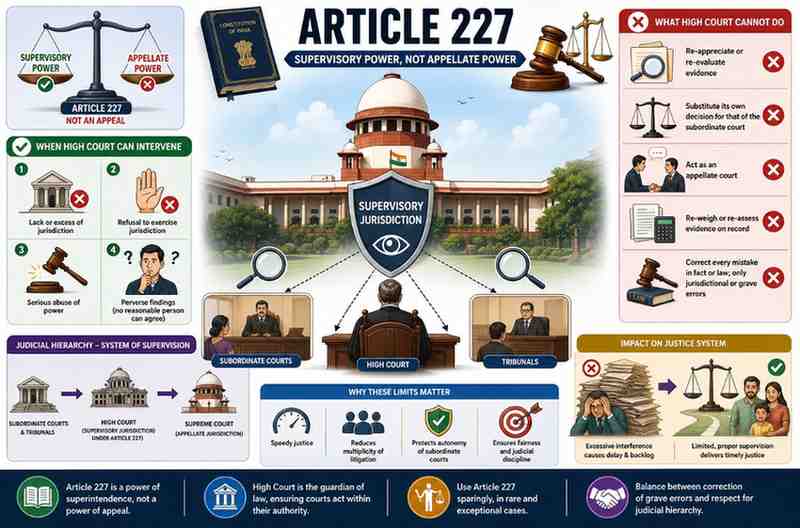
The Supreme Court has clarified that High Courts cannot act as appellate courts under Article 227 and must exercise this power only in exceptional cases.
In the recent judgment of Nandi Infrastructure Corridor Enterprises Ltd. & Anr. v. B. Gurappa Naidu, the Supreme Court (Bench: Justice Aravind Kumar and Justice N. V. Anjaria) strongly reiterated that High Courts are exceeding their limits under Article 227 by re-evaluating facts and acting like appellate courts.
Legal Issue
Whether High Courts can re-appreciate evidence and substitute their own findings while exercising jurisdiction under Article 227?
A dispute arose where a subordinate court had already examined facts and evidence and delivered its findings. However, the aggrieved party approached the High Court under Article 227, seeking a fresh evaluation of the case.
The High Court, instead of limiting itself to supervisory review, started re-analyzing the facts and effectively replaced the lower court’s decision with its own view. This raised an important constitutional question before the Supreme Court.
The Supreme Court intervened and clarified the correct position of law. It emphasized that Article 227 gives supervisory jurisdiction, not appellate power. This means the High Court is like a “guardian,” not a “decision-maker” for every case.
The Court clearly stated:
1. High Courts cannot re-appreciate evidence or re-weigh facts.
2. They cannot substitute their own decision in place of the subordinate court.
3. They cannot act as an appellate court to decide the case on merits.
However, the High Court can interfere in limited situations:
1. When a lower court assumes jurisdiction it does not have.
2. When a court refuses to exercise jurisdiction it actually has.
3. When there is a serious abuse of power.
4. When findings are so perverse that no reasonable person would reach such a conclusion.
The Supreme Court warned that frequent interference slows down trials and burdens the judicial system. It stressed that Article 227 should not be used as a substitute for appeal or revision.
In simple words, the High Court is not there to “re-decide” every case but to ensure fairness and legality in the functioning of lower courts. This judgment aims to restore discipline and efficiency in the judicial process.
Landmark Cases:
1. Waryam Singh v. Amarnath
Established that Article 227 is for keeping subordinate courts within bounds of authority.
2. Surya Dev Rai v. Ram Chander Rai
Initially widened scope, but later restricted by subsequent judgments.
3. Shalini Shyam Shetty v. Rajendra Shankar Patil
Laid down strict guidelines: use Article 227 sparingly.
4. Radhey Shyam v. Chhabi Nath
Clarified distinction between Article 226 and 227.
5. Garment Craft v. Prakash Chand Goel
Reaffirmed that Article 227 is not an appellate jurisdiction.
Importance
1. Prevents unnecessary interference by High Courts
2. Speeds up justice delivery
3. Reduces misuse of constitutional remedies
4. Protects the autonomy of trial courts
5. Helps common citizens avoid long litigation delays
Exam Snapshot
1. Article 227 = **Supervisory, NOT Appellate**
2. No re-appreciation of evidence
3. Interference only in: jurisdictional error, perversity, abuse of power
4. Key Case: Nandi Infrastructure case (latest)
5. Always mention: Waryam Singh + Shalini Shyam Shetty
अनुच्छेद 227 पर सुप्रीम कोर्ट का सख्त रुख: हाई कोर्ट अपील अदालत नहीं है
सुप्रीम कोर्ट ने स्पष्ट किया कि अनुच्छेद 227 के तहत हाई कोर्ट साक्ष्यों का पुनर्मूल्यांकन नहीं कर सकता।
हाल ही में Nandi Infrastructure Corridor Enterprises Ltd. & Anr. v. B. Gurappa Naidu मामले में सुप्रीम कोर्ट (न्यायमूर्ति Justice Aravind Kumar और Justice N. V. Anjaria) ने कहा कि हाई कोर्ट अनुच्छेद 227 का गलत उपयोग कर रहे हैं और अपील अदालत की तरह व्यवहार कर रहे हैं।
कानूनी मुद्दा
क्या हाई कोर्ट अनुच्छेद 227 के तहत साक्ष्यों का दोबारा मूल्यांकन कर सकता है?
एक मामले में निचली अदालत ने सभी साक्ष्यों को देखकर फैसला दे दिया। लेकिन एक पक्ष संतुष्ट नहीं था और सीधे हाई कोर्ट पहुंच गया। हाई कोर्ट ने मामले को केवल देखने के बजाय, साक्ष्यों को दोबारा जांचना शुरू कर दिया और निचली अदालत के फैसले को बदल दिया। यह मामला सुप्रीम कोर्ट तक पहुंचा। सुप्रीम कोर्ट ने कहा कि यह तरीका गलत है।
कोर्ट ने साफ किया कि अनुच्छेद 227 केवल निगरानी शक्ति (Supervisory Power) है, न कि अपील (Appeal)
सुप्रीम कोर्ट ने निम्न बातें स्पष्ट कीं:
1. हाई कोर्ट साक्ष्यों का पुनर्मूल्यांकन नहीं कर सकता
2. हाई कोर्ट अपना फैसला थोप नहीं सकता
3. हाई कोर्ट अपील अदालत की तरह काम नहीं कर सकता
लेकिन हाई कोर्ट निम्न परिस्थितियों में हस्तक्षेप कर सकता है:
1. जब निचली अदालत ने अपनी सीमा से बाहर जाकर काम किया हो
2. जब अदालत अपने अधिकार का उपयोग करने से मना कर दे
3. जब अधिकार का गंभीर दुरुपयोग हो
4. जब फैसला पूरी तरह से गलत (perverse) हो
कोर्ट ने यह भी कहा कि अनुच्छेद 227 का गलत उपयोग न्याय में देरी और केस की संख्या बढ़ाता है। इस फैसले से यह स्पष्ट हो गया कि हाई कोर्ट का काम केवल निगरानी करना है, न कि हर केस को दोबारा सुनना।
लैंडमार्क केस
1. Waryam Singh v. Amarnath
अनुच्छेद 227 का उद्देश्य निचली अदालतों को नियंत्रित करना है।
2. Surya Dev Rai v. Ram Chander Rai
पहले दायरा बढ़ाया गया, बाद में सीमित किया गया।
3. Shalini Shyam Shetty v. Rajendra Shankar Patil
अनुच्छेद 227 का उपयोग बहुत सीमित होना चाहिए।
4. Radhey Shyam v. Chhabi Nath
Article 226 और 227 का अंतर स्पष्ट किया।
5. Garment Craft v. Prakash Chand Goel
दोहराया कि यह अपील नहीं है।
महत्व
1. हाई कोर्ट की सीमाएं तय करता है
2. न्याय प्रक्रिया को तेज करता है
3. आम व्यक्ति को अनावश्यक मुकदमों से बचाता है
4. निचली अदालतों की स्वतंत्रता बनाए रखता है
परीक्षा के लिए मुख्य बिंदु
1. अनुच्छेद 227 = निगरानी शक्ति
2. साक्ष्य का पुनर्मूल्यांकन नहीं
3. केवल विशेष परिस्थितियों में हस्तक्षेप
4. नवीन केस: Nandi Infrastructure