“Respect Her Choice”: Supreme Court Slams Centre, Signals No Rigid Time Limit for Abortion in Rape Cases
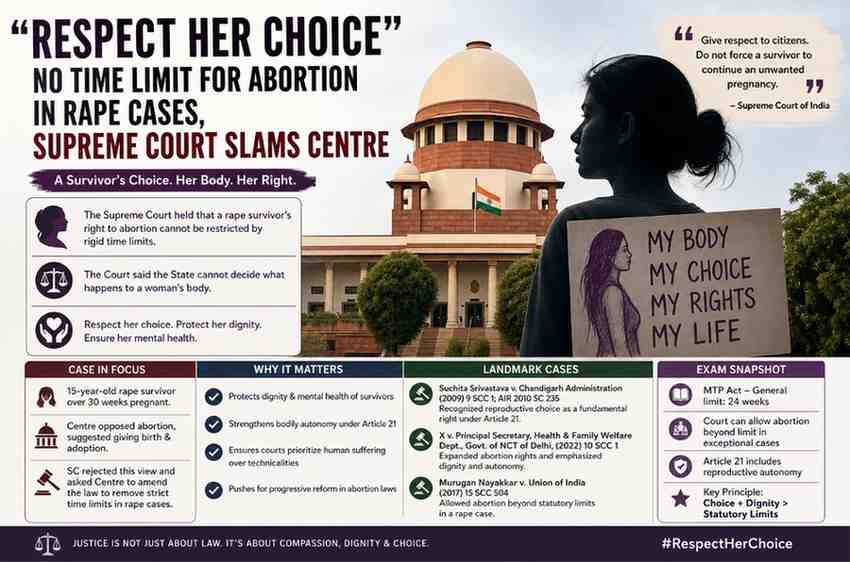
The Supreme Court of India emphasized that a rape survivor’s choice must be respected and strict time limits should not block abortion in exceptional cases.
The issue is trending because the Supreme Court of India recently criticized the Central Government for opposing abortion in a 15-year-old rape survivor’s 30-week pregnancy case and urged reconsideration of rigid legal limits under the Medical Termination of Pregnancy Act, 1971.
Legal Issue
Whether strict gestational limits under the Medical Termination of Pregnancy Act, 1971 can override a rape survivor’s right to dignity, bodily autonomy, and mental health under Article 21.
A deeply disturbing case reached the Supreme Court of India involving a 15-year-old girl, a rape survivor, who was more than 30 weeks pregnant . She approached the Court seeking permission to terminate her pregnancy. Earlier, the Court had allowed termination considering her trauma. However, later, All India Institute of Medical Sciences (AIIMS) filed a plea seeking to set aside this permission, citing medical risks due to the advanced stage of pregnancy.
The Central Government supported this objection and argued that the pregnancy had crossed the statutory limit under the Medical Termination of Pregnancy Act, 1971, suggesting instead that the girl should give birth and opt for adoption. The Court strongly rejected this mechanical approach. It observed that forcing a minor rape survivor to carry an unwanted pregnancy would intensify her trauma and suffering . The judges stated that the State cannot decide what happens to a woman’s body and must respect her autonomy.
In a sharp remark, the Court said the government must “give respect to citizens” and not compel a survivor to continue pregnancy against her will. It further directed the Centre to consider amending abortion laws to remove rigid time limits, especially in rape-related cases. The Court emphasized that legal procedures and delays should not become a source of further suffering. It reiterated that laws must evolve with societal realities and must protect dignity, mental health, and fundamental rights.
This judgment sends a strong message that human dignity and choice are above rigid legal timelines, especially in sensitive cases involving minors and sexual violence.
Landmark Cases
1. Suchita Srivastava v. Chandigarh Administration, (2009) 9 SCC 1; AIR 2010 SC 235
Recognized reproductive choice as a fundamental right under Article 21.
2. X v. Principal Secretary, Health and Family Welfare Department, Govt. of NCT of Delhi, (2022) 10 SCC 1
Expanded abortion rights and emphasized dignity and autonomy.
3. Murugan Nayakkar v. Union of India, (2017) 15 SCC 504
Allowed abortion beyond statutory limits in a rape case.
Importance
● Protects minor rape survivors from forced motherhood
● Strengthens bodily autonomy & dignity under Article 21
● Pushes for progressive reform in abortion laws
● Ensures courts prioritize human suffering over technicalities
Exam Snapshot
● MTP Act → General limit: 24 weeks
● Exception possible via Court in extreme cases
● Article 21 → includes reproductive autonomy
● Key principle: “Choice + Dignity > Statutory Limits”
● Important for Judiciary, UPSC, and Law exams
---
“उसकी पसंद का सम्मान करें”: सुप्रीम कोर्ट ने केंद्र को फटकारा, कहा—बलात्कार मामलों में सख्त समय सीमा नहीं होनी चाहिए
सुप्रीम कोर्ट ने कहा कि बलात्कार पीड़िता की इच्छा सर्वोपरि है और सख्त समय सीमा उसके अधिकारों को नहीं रोक सकती।
यह मामला चर्चा में है क्योंकि सुप्रीम कोर्ट ने हाल ही में 15 साल की बलात्कार पीड़िता के 30 सप्ताह के गर्भ के मामले में केंद्र सरकार की आलोचना की और Medical Termination of Pregnancy Act, 1971 में बदलाव पर विचार करने को कहा।
कानूनी मुद्दा
क्या Medical Termination of Pregnancy Act, 1971 की समय सीमा बलात्कार पीड़िता के गरिमा, मानसिक स्वास्थ्य और शारीरिक स्वतंत्रता (अनुच्छेद 21) के अधिकार से ऊपर हो सकती है?
एक 15 वर्षीय लड़की, जो बलात्कार की शिकार थी, 30 सप्ताह से अधिक गर्भवती हो गई थी। उसने सुप्रीम कोर्ट से गर्भपात की अनुमति मांगी। पहले कोर्ट ने उसकी स्थिति को देखते हुए अनुमति दे दी थी। लेकिन बाद में All India Institute of Medical Sciences (AIIMS) ने इस आदेश को चुनौती दी और कहा कि इतनी अधिक अवधि में गर्भपात करना खतरनाक हो सकता है। केंद्र सरकार ने भी इसका समर्थन किया और कहा कि कानून में तय समय सीमा पार हो चुकी है। उन्होंने सुझाव दिया कि बच्चा जन्म लेकर गोद (adoption) दे दिया जाए।
सुप्रीम कोर्ट ने इस तर्क को सख्ती से खारिज कर दिया। कोर्ट ने कहा कि एक नाबालिग बलात्कार पीड़िता को जबरदस्ती गर्भ जारी रखने के लिए मजबूर करना उसके दर्द और मानसिक आघात को और बढ़ाएगा। कोर्ट ने स्पष्ट कहा कि राज्य यह तय नहीं कर सकता कि महिला के शरीर के साथ क्या होगा। सरकार को नागरिकों की गरिमा का सम्मान करना चाहिए।
कोर्ट ने यह भी कहा कि केंद्र सरकार को कानून में बदलाव पर विचार करना चाहिए ताकि बलात्कार के मामलों में सख्त समय सीमा हटाई जा सके। न्यायाधीशों ने कहा कि कानून और प्रक्रिया में देरी पीड़िता के लिए और अधिक कष्ट का कारण नहीं बननी चाहिए।
यह फैसला साफ संदेश देता है कि मानव गरिमा और महिला की पसंद कानून की सख्त सीमाओं से ऊपर है , खासकर संवेदनशील मामलों में।
लैंडमार्क केस
1. Suchita Srivastava v. Chandigarh Administration, (2009) 9 SCC 1; AIR 2010 SC 235
महिला के प्रजनन अधिकार को मौलिक अधिकार माना गया।
2. X v. Principal Secretary, Health and Family Welfare Department, Govt. of NCT of Delhi, (2022) 10 SCC 1
महिला की गरिमा और स्वतंत्रता को महत्व दिया गया।
3. Murugan Nayakkar v. Union of India, (2017) 15 SCC 504
समय सीमा के बाद भी गर्भपात की अनुमति दी गई।
महत्व
● नाबालिग पीड़िताओं को जबरदस्ती मातृत्व से बचाता है
● महिलाओं के मौलिक अधिकारों को मजबूत करता है
● कानून में सुधार की दिशा दिखाता है
● तकनीकी नियमों से ऊपर इंसानियत को रखता है
परीक्षा के लिए मुख्य बिंदु
● MTP Act → सामान्य सीमा 24 सप्ताह
● कोर्ट विशेष मामलों में अनुमति दे सकता है
● अनुच्छेद 21 → गरिमा + शारीरिक स्वतंत्रता
● मुख्य सिद्धांत: “महिला की पसंद सर्वोपरि”