Right to Information (RTI): Power of Citizens and Recent Amendments
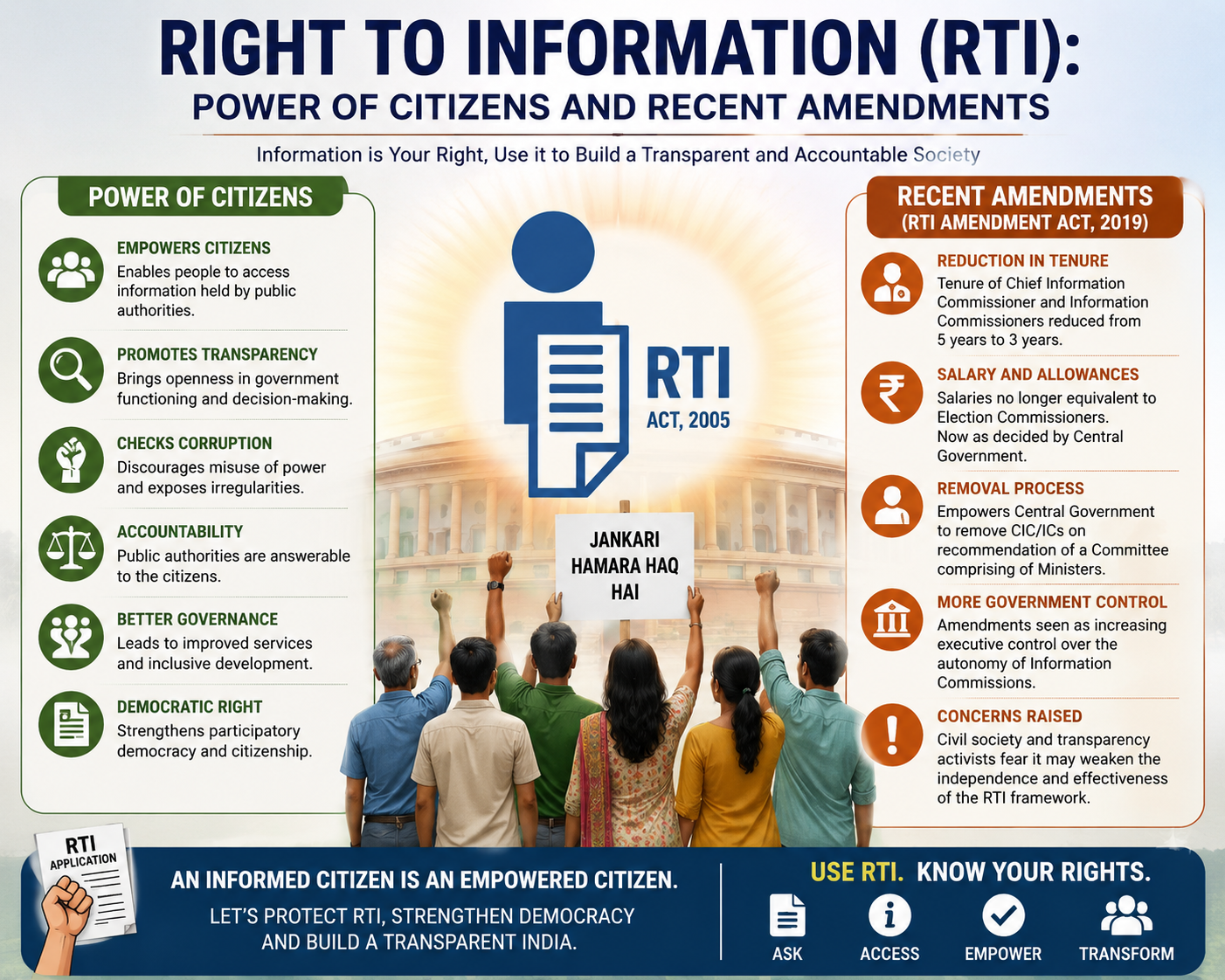
The Right to Information Act, 2005 is one of the most powerful tools given to Indian citizens. It allows any citizen to ask for information from government departments and public authorities. This law promotes transparency, reduces corruption, and makes the government more accountable.
Why RTI is Important for Citizens
Before 2005, getting information from the government was very difficult. The RTI Act changed that. It gives every Indian citizen the right to:
•Inspect government records, files, and documents.
•Ask for copies of government orders, reports, or decisions.
•Know how public money is being spent.
•Question delays or wrong decisions by officials.
Simple Process: You can file an RTI application online or offline with a small fee (usually Rs. 10). The Public Information Officer (PIO) must reply within 30 days. If denied, you can appeal.
This law has helped expose scams, get pensions and benefits faster, and improve public services.
Key Provisions of the RTI Act
Applies to all public authorities (Central, State, and local bodies).
•Section 4: Government must proactively disclose information on websites (suo motu disclosure).
•Exemptions (Section 8): Information related to national security, privacy, trade secrets, etc., can be denied.
•Information Commissions: Central and State Information Commissions hear appeals and can impose penalties up to Rs. 25,000 on officials who refuse information without reason.
Recent Amendments and Their Impact
1. RTI Amendment Act, 2019
This was a major change. Earlier, the Chief Information Commissioner (CIC) and Information Commissioners had a fixed 5-year term and their salary was equal to Election Commissioners.
The 2019 amendment gave the Central Government power to decide their tenure, salary, and service conditions.
Critics say this reduced the independence of Information Commissions. Many posts remain vacant, leading to huge backlogs in appeals.
2. Amendment through Digital Personal Data Protection (DPDP) Act, 2023 (Operational in 2025)
This is the most debated recent change. It amended Section 8(1)(j) of the RTI Act.
•Earlier: Personal information could be denied only if it had no relation to public activity or interest, unless larger public interest justified disclosure.
•Now: There is a much stronger bar on disclosing personal data. The public interest override has been weakened or removed in many cases.
•Result: It may become easier for officials to deny information by calling it “personal data.” This affects details like names of contractors, loan defaulters, or beneficiaries of schemes.
The Supreme Court has referred petitions challenging this amendment to a Constitution Bench due to its importance.d6a
Advantages of RTI
•Empowers ordinary citizens.
•Helps fight corruption and inefficiency.
•Improves governance and service delivery.
•Promotes participatory democracy.
Challenges and Concerns
•Delays and Backlogs: Many appeals take years because commissions are understaffed.
•Low Awareness: Especially in rural areas, people don’t know how to use RTI.
•Rejections and Harassment: Sometimes officials deny information or harass applicants.
•Recent Amendments: Seen by many as weakening the law’s spirit by reducing transparency and independence of watchdogs.
Misuse by some for personal grudges.
Way Forward
To make RTI stronger:
•Fill all vacant posts in Information Commissions quickly.
•Increase awareness campaigns.
•Balance privacy (from DPDP) with the right to know.
•Better digital portals and faster disposal of applications.
Conclusion
The RTI Act remains a powerful weapon in the hands of citizens even after 20 years. It has brought big positive changes in governance. However, recent amendments have raised serious questions about its future strength. Citizens must use this tool actively, while the government should protect its core spirit of transparency and accountability.
This is a general legal overview for informational purposes only – not legal advice. For filing RTIs, visit rti.gov.in or the concerned department portal.