Women’s Reservation Act 2023: Status, Challenges & the Delimitation Debate
INTRODUCTION
India’s journey toward gender equality in politics has taken a historic turn with the passage of the Women’s Reservation Act, 2023. The law promises 33% reservation for women in the Lok Sabha and State Legislative Assemblies—an ambitious step aimed at correcting decades of underrepresentation.
Despite constituting nearly half of the population, women’s participation in legislative bodies has remained disproportionately low. While the Act has been celebrated as a milestone reform, its implementation remains uncertain due to constitutional provisions, political debates, and its linkage with delimitation.
Why This Matters
Women’s political representation is not just about fairness—it directly impacts governance quality, inclusivity, and policy outcomes.
● Greater representation ensures diverse perspectives in law-making.
● It strengthens democracy by making institutions more representative.
However, without actual implementation, the Act risks remaining symbolic rather than transformative.
Deep Dive Analysis
What Does the Women’s Reservation Act, 2023 Provide?
The Act mandates:
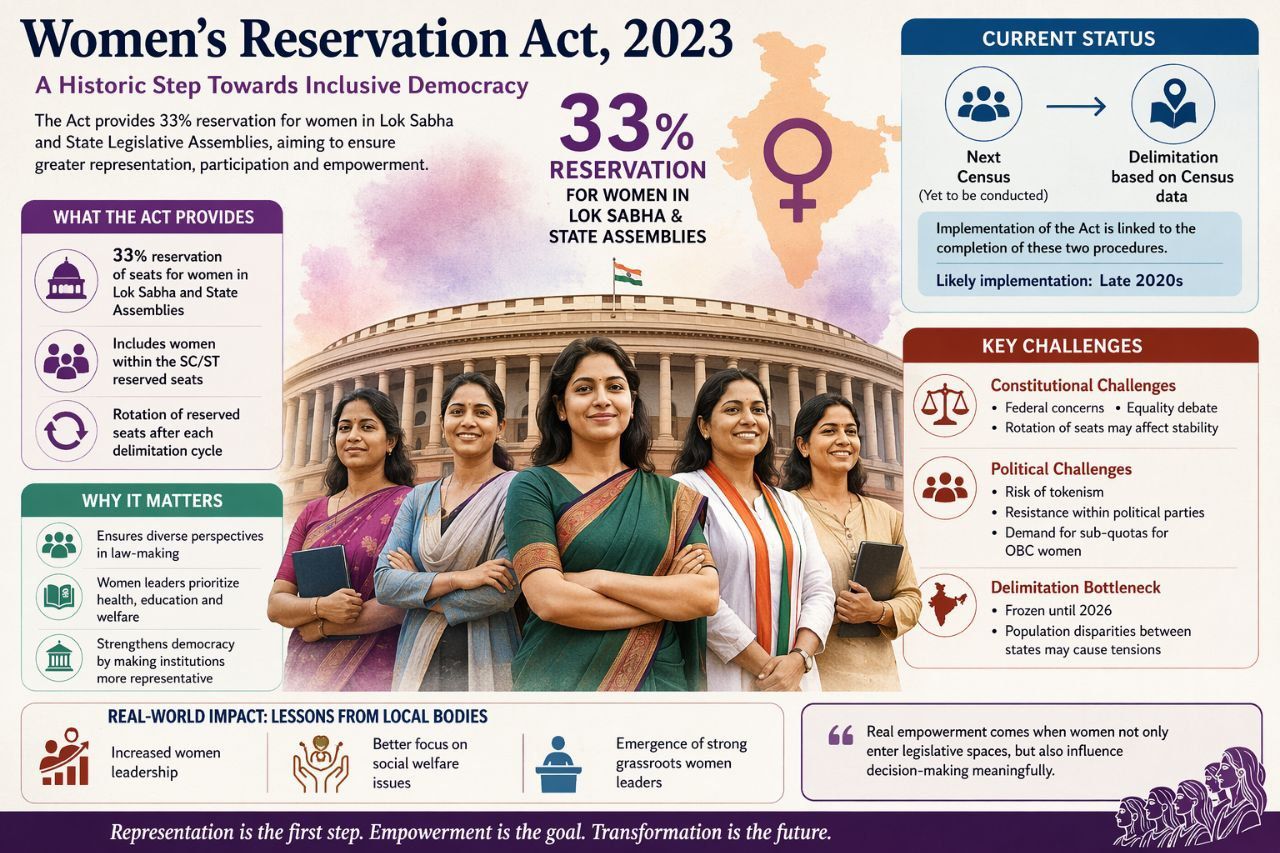
● 33% reservation of seats for women in the Lok Sabha and State Assemblies.
● Inclusion of reserved seats for women within the SC/ST quota.
● Rotation of reserved constituencies after each delimitation cycle.
This aligns with India’s earlier success in local governance, where reservation for women in Panchayats significantly increased female political participation.
Current Status of Implementation
Although the Act has been passed, it is not yet operational. Its implementation is conditional upon two key processes:
1. Next Census (yet to be conducted)
2. Delimitation exercise based on Census data
This means the reservation will likely come into effect only after these steps are completed—potentially delaying implementation until the late 2020s.
The Delimitation Link: A Critical Bottleneck
Delimitation refers to the redrawing of constituency boundaries based on population changes.
Why is it important here?
● Reservation will apply to newly delimited constituencies.
● It ensures equitable distribution of reserved seats across regions.
The challenge:
● Delimitation has been frozen until 2026.
● Population disparities between states could trigger political tensions.
Thus, the linkage creates a structural delay, raising concerns about political intent versus practical delivery.
Constitutional Challenges
1. Federal Concerns
States may resist changes due to fears of losing political influence post-delimitation.
2. Basic Structure Debate
Some critics argue that excessive reservation could affect the principle of equality, although courts have historically upheld such affirmative actions.
3. Rotation of Seats
Frequent rotation may discourage long-term political investment by candidates in constituencies.
Political Challenges
1. Tokenism vs Real Empowerment
There is a concern that women candidates may be proxies for male politicians.
2. Party-Level Resistance
Political parties may struggle to adjust internal power dynamics.
3. Demand for Sub-Quotas
OBC women’s representation remains a debated issue, with demands for separate quotas within the 33%.
Broader Impact on Indian Democracy
If implemented effectively, the Act could:
● Transform political culture
● Encourage grassroots leadership among women
● Improve governance outcomes
However, delays and design issues could dilute its intended impact.
Key Takeaways
●The Act ensures 33% reservation for women in Parliament and State Assemblies.
● Implementation depends on Census and delimitation, causing delays.
● Constitutional and political challenges remain significant.
● Delimitation is the central bottleneck in execution.
● Real empowerment depends on effective participation, not just representation.
Real-World Application
Example 1: Panchayati Raj Institutions
Reservation for women in local bodies has led to:
●Increased female leadership
● Better focus on social welfare issues
● Emergence of grassroots women leaders
This suggests similar outcomes could be expected at higher legislative levels.
Example 2: State-Level Political Trends
States with higher female representation often show:
● Improved gender-sensitive policies
● Better public service delivery
This reinforces the need for scaling representation at the national level.
Conclusion
The Women’s Reservation Act, 2023 is a landmark reform with the potential to reshape India’s political landscape. However, its success depends not just on legislative approval but on timely and effective implementation.
The linkage with delimitation, while structurally logical, raises concerns about delays and political complexities. Moving forward, the focus must shift from symbolic legislation to actionable change—ensuring that women not only enter legislative spaces but also influence decision-making meaningfully.
The real question is not whether the Act is historic—it certainly is—but whether India can translate this historic intent into real political transformation.