UNIFORM CIVIL CODE IN INDIA
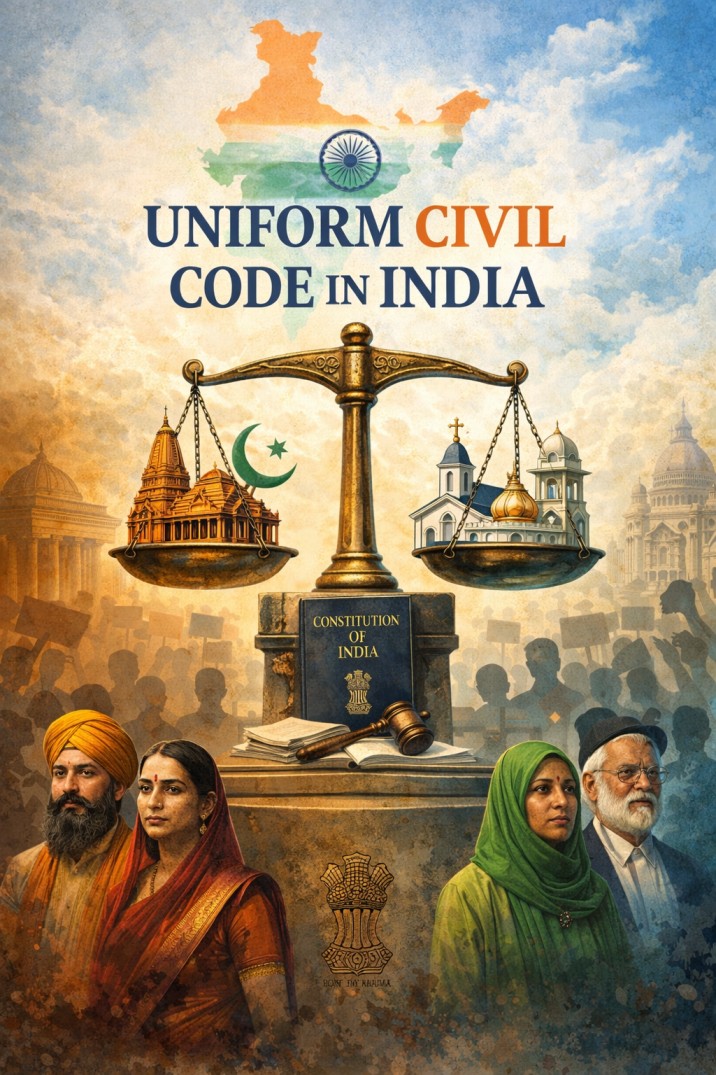
Introduction
The Uniform Civil Code (UCC) is one of the most debated and discussed constitutional ideas in India. It refers to the proposal of introducing a single set of civil laws applicable to all citizens, irrespective of religion, governing personal matters such as marriage, divorce, inheritance, adoption, and maintenance.
In a country known for its cultural and religious diversity, the UCC stands at the intersection of law, religion, secularism, gender justice, and constitutional morality. While envisioned by the framers of the Constitution, its implementation continues to raise legal and social questions even today.
What is the Uniform Civil Code?
A Uniform Civil Code aims to replace the existing system of religion-based personal laws with a common civil law applicable to all citizens.
At present:
Hindus, Sikhs, Jains, and Buddhists are governed by Hindu personal laws.Muslims are governed by Muslim law.
Christians and Parsis follow their respective personal laws.
The UCC seeks to ensure that civil rights and obligations are governed uniformly, irrespective of religious identity.
Constitutional Basis of the Uniform Civil Code
Article 44 of the Indian Constitution:
The constitutional foundation of the UCC lies in Article 44, which is part of the Directive Principles of State Policy:
“The State shall endeavour to secure for the citizens a Uniform Civil Code throughout the territory of India.”
Key constitutional points:
Directive Principles are non-justiciable, meaning they are not enforceable by courts.They act as guiding principles for governance. Article 44 reflects the vision of a secular and egalitarian civil framework.The framers deliberately placed UCC under Directive Principles to allow gradual and consensual implementation.
Historical Background of the UCC Debate
● Pre independence era:
Under British rule, laws related to crimes and contracts were unified, but personal laws were left untouched to avoid social resistance.
● Constituent Assembly Debates
During the drafting of the Constitution:
Supporters argued that UCC would ensure equality and national unity, while opponents feared interference with religious practices. The UCC was included as a directive goal rather than a fundamental right.
● Judicial Interpretation and Important Case Laws:
Indian courts have repeatedly highlighted the need for legal uniformity in personal laws.
1. Shah Bano Case (1985)
The Supreme Court held that a divorced Muslim woman is entitled to maintenance under criminal law, emphasizing gender justice and the need for a UCC.
2. Sarla Mudgal Case (1995)
The Court observed that differences in personal laws were being misused and strongly reiterated the importance of implementing Article 44.
3. John Vallamattom Case (2003)
The Supreme Court noted that unequal personal laws contradict the principles of secularism and equality.
While courts cannot enforce the UCC, these judgments reflect judicial concern over legal fragmentation.
Arguments in Favour of the Uniform Civil Code
1. Equality Before Law
A UCC would strengthen Article 14, ensuring equal civil rights for all citizens.
2. Gender Justice
Several personal laws contain provisions that discriminate against women. A uniform law can promote:
● Equal inheritance rights
●Fair divorce procedures
●Uniform maintenance provisions
3. National Integration
A common civil law fosters a sense of shared citizenship, reducing divisions based on religion.
4. Strengthening Secularism
UCC separates civil law from religious doctrine, reinforcing constitutional secularism.
5. Simplification of Legal System
One uniform law reduces contradictions, ambiguity, and misuse of personal laws.
Arguments Against the Uniform Civil Code
1. Right to Religious Freedom
Critics argue that personal laws are part of religious practice protected under Article 25.
2. Cultural Diversity
India’s diversity is unique, and a single law may not reflect the customs of all communities.
3. Absence of Social Consensus
Without widespread acceptance, implementation may lead to social resistance.
Uniform Civil Code and Indian Secularism
Indian secularism does not strictly separate religion from the state. Instead, it allows state intervention for social reform.
A carefully drafted UCC does not eliminate religious freedom but ensures that civil rights are governed by constitutional values rather than religious norms.
Goa: The Only Example of a Uniform Civil Law
Goa follows a common civil code where:
●Civil laws apply uniformly across communities.
●Marriage registration is compulsory.
●Equal inheritance rights are recognized.
Though not perfect, Goa demonstrates that legal uniformity and cultural diversity can coexist.
Contemporary Relevance of the Uniform Civil Code
The UCC has gained renewed attention due to:
●Growing focus on women’s rights
●Judicial observations
●Legal reform debates
●Public discourse on equality and secularism
A balanced approach towards UCC may include:
●Gradual reform of personal laws
●Gender-just amendments
●Wide public consultation
●Neutral and inclusive drafting
The objective should be justice and equality, not forced uniformity.
Conclusion
The Uniform Civil Code represents a constitutional aspiration aimed at ensuring equality, dignity, and justice for all citizens. While challenges remain, the debate reflects India’s evolving legal and democratic framework.A well-considered and inclusive UCC can strengthen constitutional values while respecting India’s pluralistic