Prisoners' Right
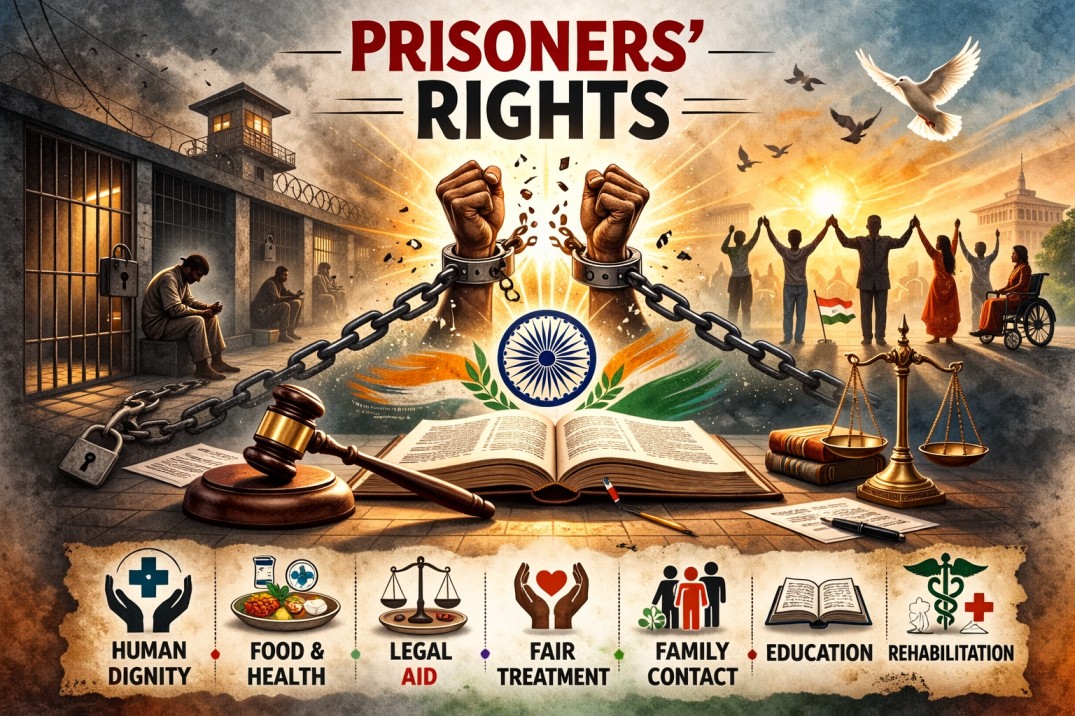
Who is a Prisoner?
According to the “Model Prison Manual, 2016”, a prisoner is
any person confined in a prison under the order of a competent authority.
These individuals are categorized into:
CONVICTS, UNDER TRIALS AND CIVIL PRISONERS.
Perspectives on “Crime and Punishment”
THE HOSPITAL THEORY: Mahatma Gandhi stated that, “Crime is
the outcome of a diseased mind and jails must have an environment of hospital
for treatment and care”.
HUMAN DIGNITY: The Supreme Cort of India states that a
prisoner is a human being and should be entitled to basic human rights and
dignity, regardless of the crime committed.
THE “RETAINED RIGHTS” THEORY: The court in the landmark case of the State
Of Andhra Pradesh vs. Challa Ramkrishna Reddy, held that a prisoner
must enjoy all the fundamental rights except for those which are being
specifically curtailed by the Indian Constitution due to their confinement.
Key Statutes that govern these rights in India are:
The Constitution of India. (Specifically in Articles 14,19
and 21)
The Prisons Act, 1894. (Primary legislation for prisons
rights and regulations)
The Code of Criminal Procedure, 1973. (Bhartiya Nagrik
Suraksha Sanhita, 2023) (Provides rights like speedy trial, medical examination
and many more)
Model Prison Manual, 2016. (Modern guidelines for prison
management and inmate welfare)
There are rights related to prison and prisoners that were
enforced by certain landmark judgements.
A.
Right to free Legal Aid: Suk
Das vs. Union Territory of Arunachal Pradesh.
B.
Right against the
Custodial Violence: Sunil Batra vs. Delhi Administration.
C.
Rights of Women
Prisoners: Sheela Barse vs. State of Maharashtra.